MJF 3D Printing Service: The Speed of Innovation
Multi Jet Fusion (MJF) represents the pinnacle of high-volume additive manufacturing. Developed by HP and refined through Prototal’s industrial expertise, MJF utilizes a unique thermal control process to produce parts with exceptional mechanical properties and surface uniformity.
The technology produces functional nylon prototypes and end-use components with consistent mechanical properties that in many applications rival injection molding, while still offering the flexibility of rapid prototyping when time-to-market is critical. For projects requiring runs of up to 100,000 units with rapid turnaround times, MJF is the definitive technology for digital mass production.


Industrial MJF Material Portfolio

PA 11
Offering superior impact resistance and ductility compared to Nylon 12, PA 11 is derived from renewable sources, making it a more sustainable, high-performance option.
- High impact resistance and ductility
- Bio-based polymer composition
- Excellent chemical resistance against fuels, oils, and greases
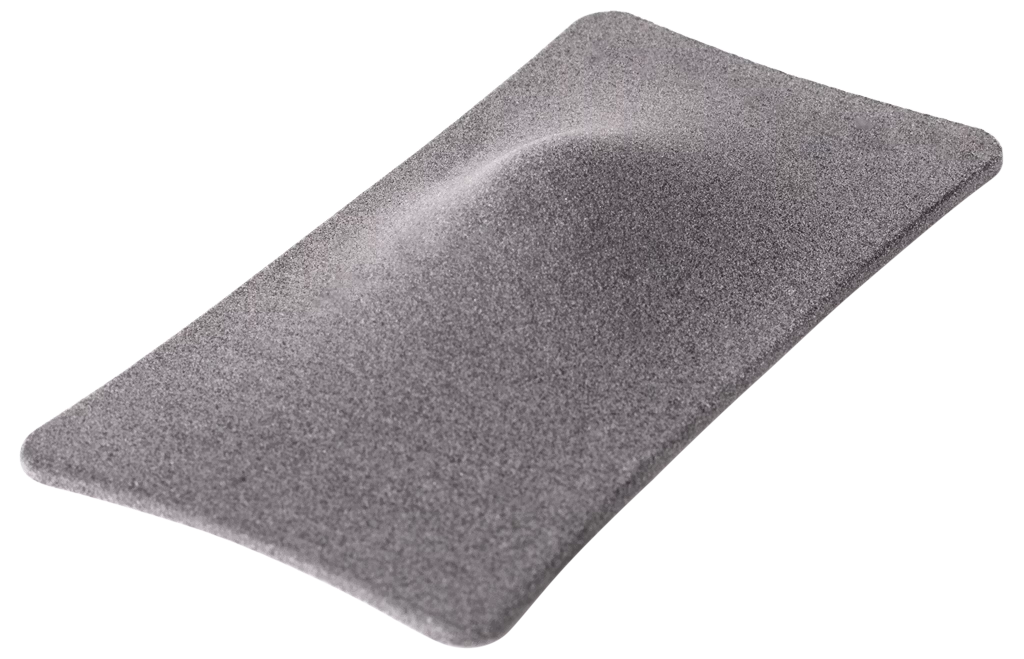
PA 12
Known for its exceptional strength and fine resolution, this Nylon 12 powder provides a smooth finish and excellent chemical resistance, perfect for complex, detailed parts.
- Balanced mechanical profile
- High-density structure
- Consistent dimensional accuracy
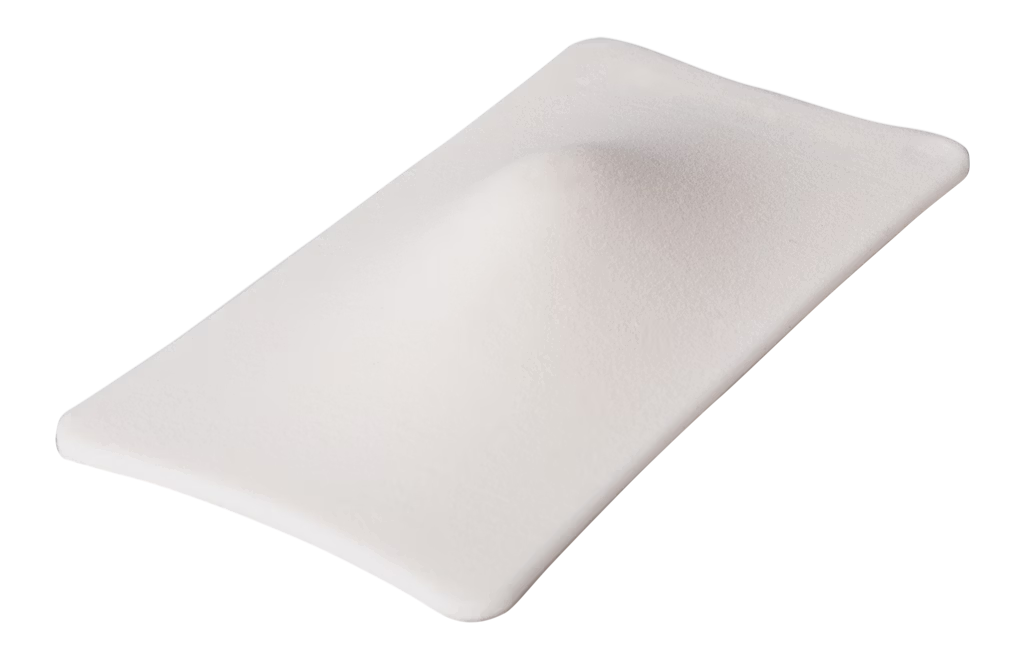
PA 12 White (light grey)
For applications requiring high aesthetic clarity and color versatility, PA 12 White (light grey) provides excellent detail resolution and a clean finish, ideal for medical housings and consumer goods.
- Light grey base material allowing for more vibrant dyecoloring
- Balanced mechanical profile
- Consistent dimensional accuracy
PA 12 GB
Reinforced with 40% glass spheres, this material offers superior dimensional stability and high stiffness, making it the definitive choice for structural components that face thermal stress.
- High structural rigidity provided by glass bead reinforcement
- Elevated thermal resistance
- Optimized for high-load applications
How Multi Jet Fusion Work Differs From Other Processes
To appreciate what makes Multi Jet Fusion work so effectively, it helps to understand the underlying mechanics. Unlike laser-based powder bed systems that trace each contour point-by-point, MJF uses an inkjet array to deposit fusing and detailing agents across an entire bed of nylon powder. An overhead infrared heat source then fuses each solid layer in a single pass – and then the process repeats until the build is complete.
This layer-by-layer approach delivers significantly faster build speeds and, thanks to voxel-level precision, produces parts with nearly identical strength across the X, Y, and Z axes. The result is a near-isotropic component with consistent mechanical properties that engineers can rely on for functional applications.
The Step-by-step Process in MJF
- Material Deposition: A thin layer of polymer powder (typically PA12 or PA11) is spread across the build area.
- Agent Application: An inkjet print head sweeps across the bed, depositing a fusing agent where the part is to be solid and a detailing agent around the contours to ensure sharp edges and smooth surfaces.
- Thermal Fusion: Heat lamps pass over the bed, fusing the areas treated with the fusing agent. Because the entire layer is fused in one pass, MJF offers significantly faster build speeds than point-to-point laser sintering.
- Voxel-Level Precision: By controlling the properties of each “voxel” (a 3D pixel), MJF achieves near-perfect isotropy, meaning the parts have nearly identical strength in the X, Y, and Z axes.
- Cooling and Extraction: After the build, the “natural cooling” process ensures dimensional stability before the parts are excavated from the powder bed and moved to post-processing.

Engineering Your Perfect Surface for your MJF Part
We empower you to tailor every surface to your exact requirements — whether your application demands the high-gloss, fluid-tight seal, a refined tactile haptic, or the vibrant, scratch-resistant branding with dyecoloring.
By utilizing industry-leading technology from partners like AMT, AM Solutions and DyeMansion, we ensure that your parts don’t just meet mechanical tolerances but also achieve the specific resilience your project requires.
A New Standard of Precision
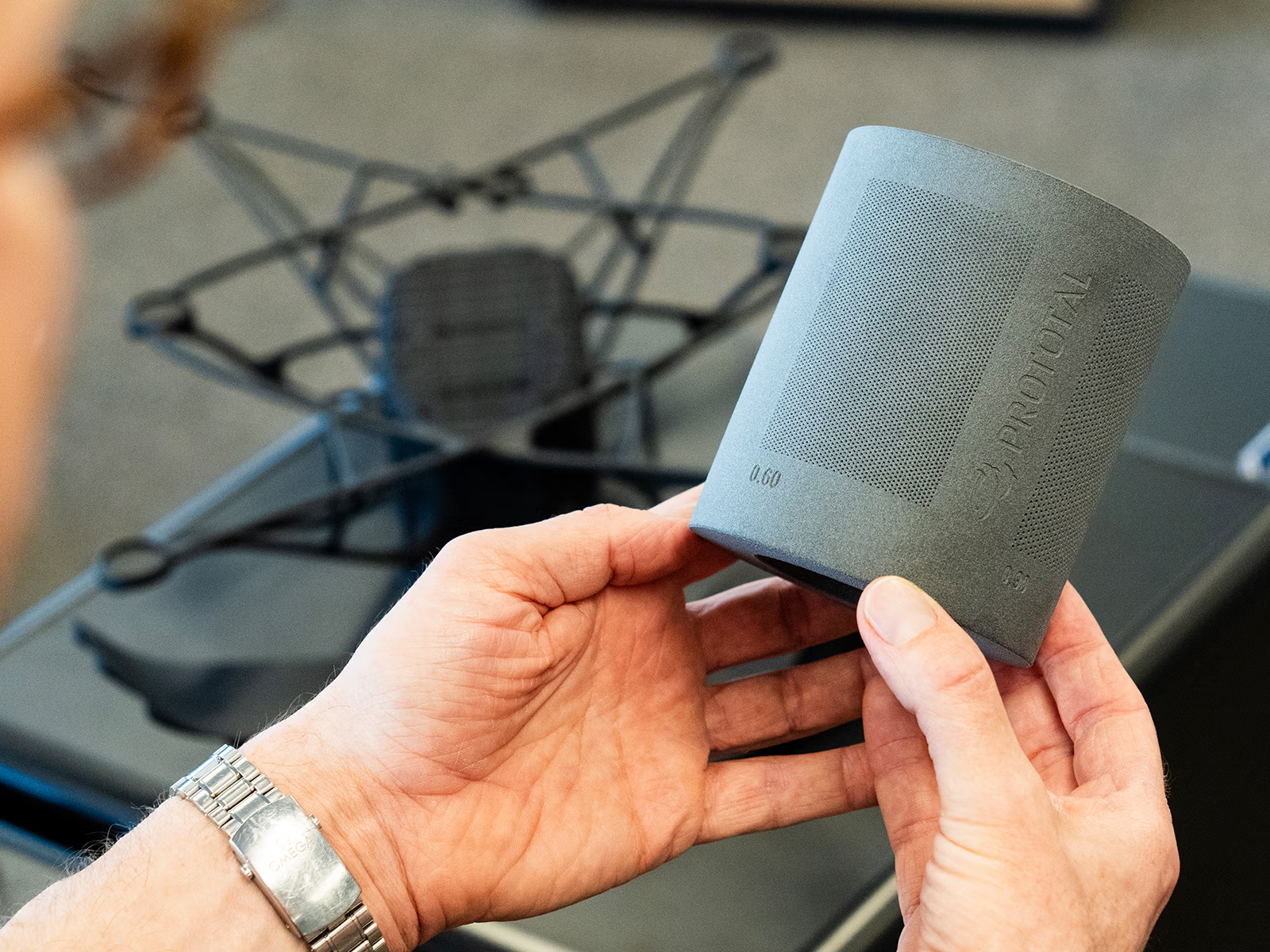
Leveraging our calibrated HP Multi Jet Fusion (MJF) technology, we push the boundaries of high-performance industrial hardware. By utilizing PA 11 to produce high-density components with intricate features, including hole diameters as low as 0.4 mm, we enable the creation of advanced filtration systems and complex cooling manifolds designed for the most demanding environments.
This specialized combination of MJF precision and PA 11 durability is the same technical foundation we use to engineer high-efficiency tooling for molded fiber packaging. This allows for superior air and water evacuation in the molding process, ensuring faster cycle times and refined surface finishes for sustainable packaging solutions.
Datasheets at a Glance
| MJF | Density (g/cm³) | Tensile strength (MPa) | Tensile modulus (MPa) | Elongation at break | Charpy IS (kJ/m² at 23°C) | HDT (°C @ ~1.8 MPa) |
|---|---|---|---|---|---|---|
| PA 11 | 1.05 | XY 52 | XY 1800 | XY 50% | XY 5 (notched) | XY 54 |
| PA 12 | 1.01 | XY 48 | XY 1700 | XY 20% | XY 3.5 (notched) | XY 95 |
| PA 12 GB | 1.3 | XY 30 | XY 2500 | XY 10% | XY 3 (notched) | XY 114 |
| PA 12 W | 1.02 | XY 49 | XY 1900 | XY 17% | XY 4.5 (notched) | XY 94 |
The data shown is indicative and intended for reference only. Material properties may vary depending on printing conditions and technology. Although care has been taken to ensure accuracy, typographical or data entry errors may occur. Please be aware that certain values in this table can be derived from different testing standards made from our suppliers, for authoritative specifications, please refer to the original manufacturer datasheets provided under each material.
3D Print Guidelines
Our helpful guides are specifically designed to assist you before submitting your design to us. We always strive to achieve the best possible outcome, and by following our guidelines, you can be confident that your design will be of the highest quality.
Get in touch with us if you need guidance, we are happy to help you!
Enabling the Next Industrial Revolution Together


Explore our HP certified facilities near you

Bring Your Design to Life
"*" indicates required fields
By submitting this form, you agree to our Privacy Policy. We use the information you provide to respond to your inquiry and provide requested manufacturing services.

Quote Your Next Project
Looking for high-quality industrial 3D printing solutions tailored to your needs? Our team is ready to provide a detailed quote for your project. Simply share your specifications, and we’ll deliver a clear, competitive estimate — no surprises, just precision and reliability.
Why choose us?
- 3D printing solutions for any scale and complexity
- Fast and accurate quoting process
- Local presence close to your business and business needs

FAQs
Do you have questions regarding MJF Industrial 3D Printing? Find the most common questions and answers about the subject here.
Our biggest industrial MJF platforms from HP can accommodate build volumes up to 380 x 284 x 380 mm depending on part geometry. However, for larger components, we can utilize advanced bonding techniques allowing for the creation of massive assemblies.
While MJF parts are naturally porous due to the sintering process, we offer specialized sealing with vapor smoothing. These post-processing steps close the surface pores, making the components airtight and resistant to fluid ingress, which is essential for tanks, manifolds, and ducting.
Yes, MJF PA 12 is approved for skin contact provided the correct post-processing and finishing.
We offer a range of post-processing services to ensure your 3D printed parts meet the highest standards of quality, precision, and aesthetics.
MJF 3D Printing Post-Processing
- Vapor Smoothing
- Vibratory Finishing
- Bead Blasting
- Coloring
- Primer, Painting, coating & lacquering
- Threaded/non-threaded inserts
- Assembly
Manufacturing should not be transactional. At Prototal we value a partnership, which is why you will get a dedicated contact person close to your operations that knows your business and business needs. To start our future partnership, please reach out to the local team within your area that can be found under Contact us or send us an e-mail:
- Norway: post@prototal.no or +47 74 09 06 00
- Sweden: am@prototal.se or +46 36 38 72 00
- Denmark: 3dp@prototal.dk or +45 43 99 37 36
- United Kingdom: info@prototaluk.com or +44 1635 635855
- Italy: info@prosilas.com or +39 733 892665
- Austria, Germany & Switzerland: 3dp@prototalgroup.at or +43 5572 52946-9
As a flexible partner we can offer lead times down to 1 working day depending on the selection of material, post-processing, quality control and your business location. Usually, you can expect a lead time within the range of 2-3 working days, depending on same variables as stated above.
*While Prototal offers industry-leading turnaround times, all delivery schedules are estimates based on standard operating conditions. Final lead times are subject to local availability, part geometry, build volume, and specific material selection. Complex geometries requiring extensive support structures or high-performance materials may require additional processing time to ensure structural integrity and dimensional accuracy.


