Fashion 3D Printing: Redefining the Supply Chain
The traditional fashion cycle is often hindered by rigid manufacturing constraints and the environmental burden of overproduction. At Prototal, we provide the digital infrastructure to bypass these limits. By integrating industrial 3D printing into your collection’s lifecycle, we enable a “design-to-shelf” timeline measured in weeks, not months.
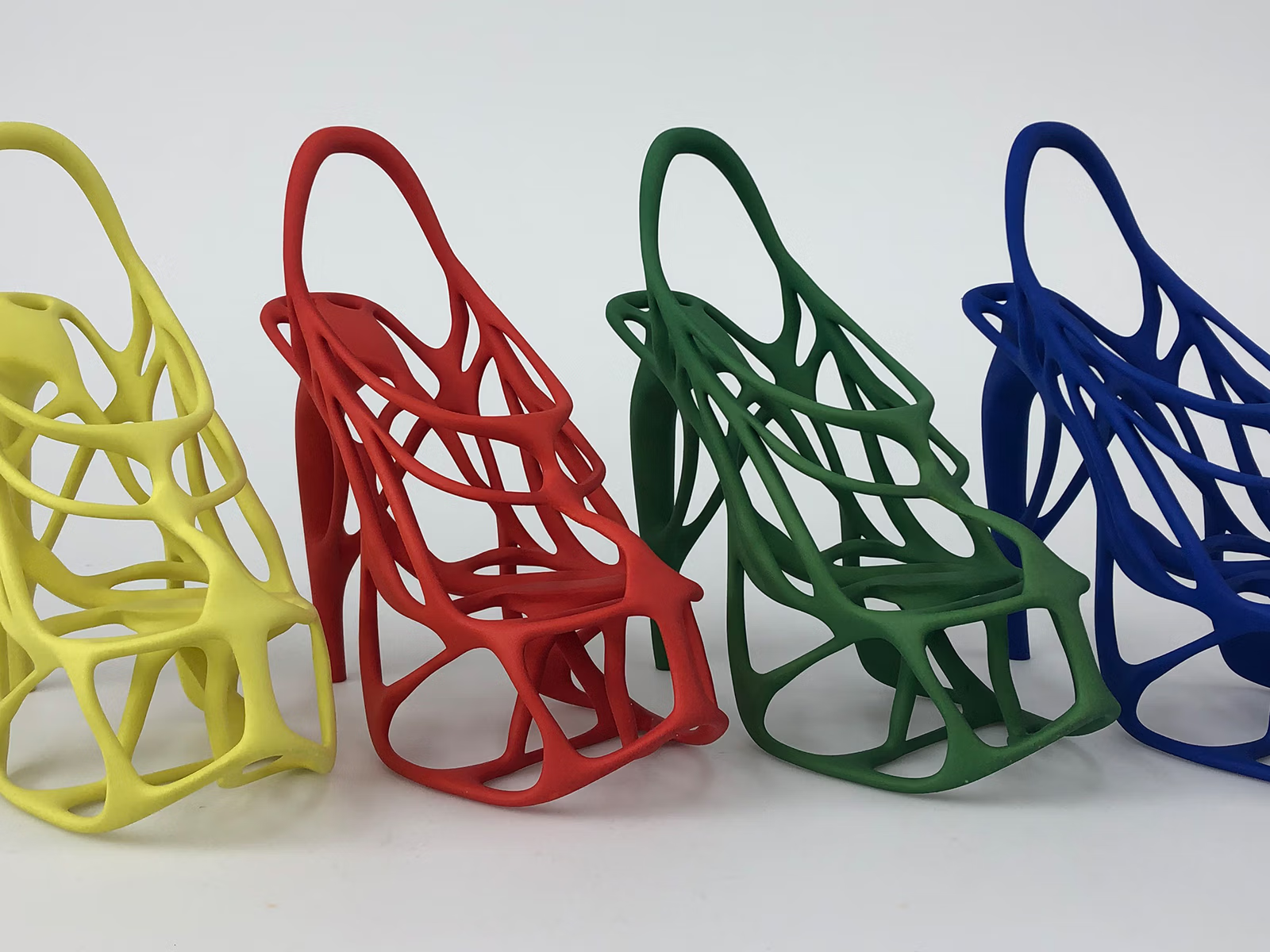
From high-performance footwear components to avant-garde accessories, our technology allows you to respond to market trends in real-time while achieving a level of geometric complexity impossible with conventional methods.

Why Choose AM for Fashion?
The shift to Additive Manufacturing is a strategic move toward a leaner, more responsive business model. It allows brands to treat their inventory as a digital library, producing only what the market demands and eliminating the costly “push” model of traditional retail.
Extreme Material Flexibility with TPU
Footwear and wearable tech require a delicate balance of strength and elasticity. By utilizing TPU (Thermoplastic Polyurethane), we can print components with varying shore hardness in a single build. This allows for the creation of lattice midsoles that offer superior energy return, or flexible garment accents that mimic the drape of traditional textiles while maintaining industrial durability.
Complexity for Free & Part Consolidation
In traditional accessory and jewelry manufacturing, complex designs often require multiple molds and assembly steps. 3D printing enables “Complexity for Free,” allowing us to consolidate multi-part assemblies into a single, seamless component. This removes potential failure points like welds or fasteners, resulting in a more robust and aesthetically refined product.
Zero-Cost Customization & Personalization
Additive Manufacturing removes the financial penalty of “unique” items. Whether you are producing a limited-run collaboration or bespoke eyewear tailored to an individual’s biometric data, AM allows for mass-customization without the need for new tooling. This agility is the definitive advantage for brands looking to offer exclusive, high-value collections.
Rapid Trend Integration & Prototyping
The ability to “decode” market trends and move to production within 2–3 months is a massive competitive edge. Our infrastructure allows you to iterate designs overnight. You can validate the fit, feel, and aesthetics of a new concept in high-fidelity resins or engineering polymers, ensuring the collection is perfected before it ever hits the runway or the retail floor.
Drastic Reduction in Material Waste
Traditional fashion production is one of the world’s most resource-intensive industries, often discarding up to 80% of raw materials. Our additive processes are inherently lean; we use only the material required for the part. By producing closer to the point of demand and recycling excess powders, we help you achieve your ESG goals and significantly reduce the carbon footprint of your supply chain.

Engineering Your Perfect Surface
We empower you to tailor every surface to your exact requirements — whether your application demands the high-gloss, a refined tactile haptic, or the vibrant, scratch-resistant branding with dyecoloring.
By utilizing industry-leading technology from partners like AMT, AM Solutions and DyeMansion, we ensure that your parts don’t just meet mechanical tolerances but also achieve the specific resilience your project requires.
Manufacturing Services for Fashion


We can now wait to start production until 2–3 months before a launch
This ‘near-production’ capability, both in timing and proximity, gives us a clear competitive edge, allowing us to stay agile as fashion evolves. It ensures we can accurately read the market and tailor our collections to the latest trends.
— Allan Gröndahl Petersen, CEO at Monoqool


The Death of Overproduction
Can small fashion enterprises benefit from 3D printing? Yes. For nearly a decade, Danish eyewear manufacturer Monoqool has designed and produced 3D-printed glasses in close collaboration with Prototal.
Bring Your Design to Life
"*" indicates required fields
By submitting this form, you agree to our Privacy Policy. We use the information you provide to respond to your inquiry and provide requested manufacturing services.
FAQs
Do you have questions that needs answering? Here you can find the most common questions and answers.
Industrial 3D printing isn’t just for the runway; it is built for the real world. By using engineering-grade polymers like PA 2200, PA 11 and TPU, we produce components that meet rigorous standards for UV stability, chemical resistance, and mechanical fatigue. Our TPU materials, in particular, offer excellent hydrolysis resistance and flexibility, ensuring that shoe midsoles or flexible accents maintain their structural integrity.
Absolutely. The “layered” look is a thing of the past. Through our Precision Finishing infrastructure like Vapor Smoothing or vibratory finishing, we can transform raw, porous prints into sealed, high-gloss, or matte surfaces that are indistinguishable from injection-molded plastic. This process not only improves the aesthetics but also enhances the “hand-feel” and skin compatibility, which is critical for eyewear, jewelry, and wearables.
It depends… and this is where our LTV tool provides the most value. For high-complexity designs or products requiring multiple size variants, 3D printing often beats traditional manufacturing by eliminating the massive CapEx of different molds. By avoiding the “minimum order quantity” trap of overseas factories, you reduce the risk of unsold deadstock. We help you find the exact “crossover point” where additive manufacturing provides the best ROI for your specific volume.


