Vacuum Casting Services: Production-Grade Parts from High-Performance Silicones
Vacuum casting is the strategic choice for functional prototypes, pre-series, and specialized small series. By utilizing a master model — often created via 3D printing — we use reinforced silicone molds to produce parts that replicate complex geometries. The vacuum casting process allows you to achieve the tactile, mechanical, and optical properties of injection-molded parts while avoiding the high lead times and costs of traditional tooling.


Engineering for Every Requirement
We offer a diverse range of resins to match your specific mechanical and aesthetic needs. Our team provides individual advice to help you select the ideal chemistry for your application.
Polyurethane (PU)
Primarily used for housings, covers, and functional components. This material offers a balanced profile of strength and durability, making it the go-to choice for pre-series functional testing.
Special PU Resins
For projects with demanding mechanical, thermal, or optical specifications. This includes transparent resins for lenses or heat-resistant resins for under-the-hood automotive applications.
Silicone & Rubber
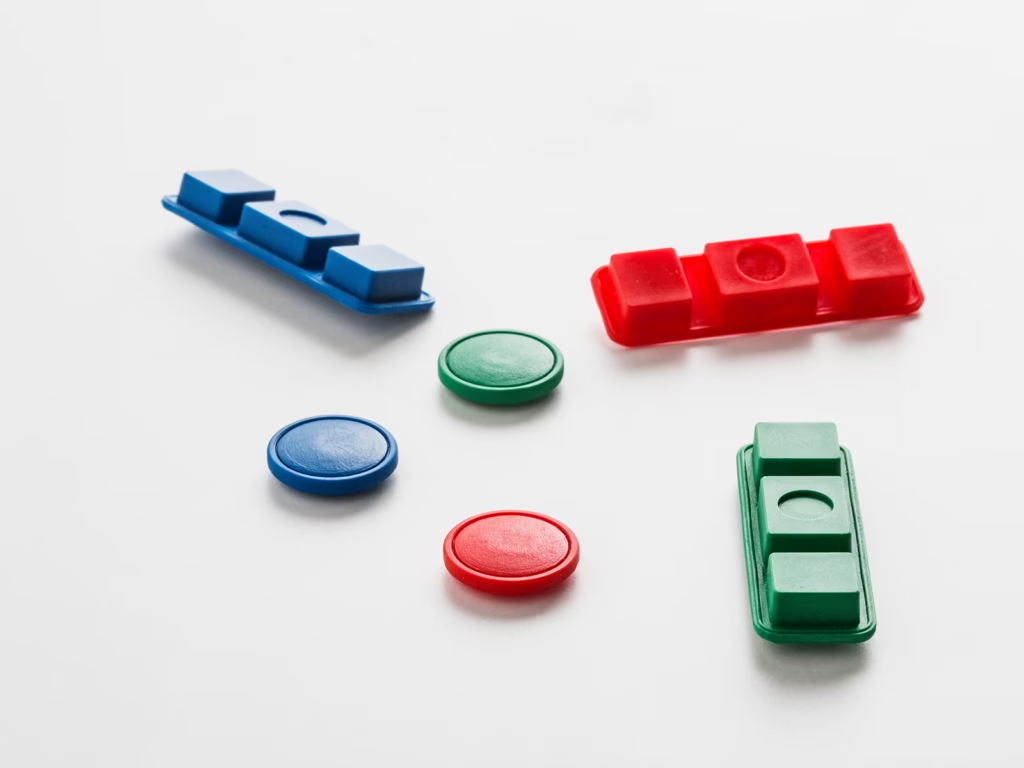
We manufacture seals, hoses, protective caps, and shock absorbers in a wide range of Shore hardnesses (10 to 85 Shore A). This allows for the production of soft-touch components or high-vibration dampers in low volume production.
Customization and Finishing Options
Vacuum casting delivers parts that look and perform exactly like final consumer products. We customize your components by adding glass fibers for extra strength or flame retardants for safety. You can choose from a wide range of colors to match your brand, including transparent or crystal-clear parts for lenses, covers, and display components. We also provide diverse surface textures such as professional spark-eroded finishes, spray putty, or high-gloss surfaces for a premium look.
Reinforced Tooling
The foundation of our vacuum casting excellence lies in our High-Precision Silicone Molds. While standard silicone tools often degrade after 20 cycles, we utilize specially reinforced silicone combined with high-strength additives to ensure superior results.
Our reinforced tooling approach directly improves your project outcomes by increasing:
- Dimensional accuracy with minimized shrinkage and better tolerance control across the entire batch
- Extended tool life, reducing the cost-per-part for longer runs
- Consistent surface quality from the first part to the last.
While classic molds reach their limit early, our optimized tools enable significantly higher quantities — up to 1,000 parts per mold when using standard PU resins. Initial costs are incurred only once, and the mold remains available for future production runs.
Vacuum Casting at a Glance
| Feature | Strategic Benefit |
|---|---|
| Tooling Cost | One-time initial cost, significantly lower than tools for injection molding |
| Scalability | Ideal for 10 to 1,000+ parts. |
| Speed | First parts delivered in days, not months. |
| Complexity | Capable of deep undercuts and complex internal features. |
Empowering Green Fuel for Cars with Easee
How do you take a revolutionary EV charger from a bold concept to a European success story? When Easee set out to redefine smart charging, they needed prototypes that matched their innovative DNA.

Bring Your Design to Life
"*" indicates required fields
By submitting this form, you agree to our Privacy Policy. We use the information you provide to respond to your inquiry and provide requested manufacturing services.
FAQs
Whether you are navigating the transition from prototyping to serial production or optimizing an existing supply chain, we are here to provide the technical clarity you need. If your specific challenge isn’t covered here, our application engineers are ready to discuss your project’s unique requirements and help you find the most efficient path to production.
Vacuum casting is a low-volume manufacturing process that produces plastic and rubber parts with the look and feel of injection-molded components. It uses a silicone mold, made from a 3D-printed master model, to cast liquid resin under vacuum. The vacuum removes air bubbles and ensures fine details, textures, and undercuts are captured precisely.
The process of vacuum casting starts with a master model — typically 3D printed — which is encased in silicone to produce a precision mold. The mold is then filled using two-component polyurethane or silicone resin, degassed inside a vacuum chamber to deliver bubble-free parts with properties comparable to injection-molded components. For best results, we recommend a minimum wall thickness of 1.5 mm. This makes vacuum casting ideal for prototypes, pre-series, and small-batch consumer goods.
Choose our vacuum casting service when you need specific material properties — like high-clarity transparency or soft rubber elastomers — that 3D printing cannot yet perfectly replicate. It is also the preferred choice when you need a high-quality surface finish across a batch of 50 to 500 parts.
Yes. Many of our customers in the medical and specialty vehicle sectors use vacuum cast parts for final product production. Because the materials mimic the properties of injection-molded thermoplastics, they are fully functional and durable for long-term use.


