Full Color 3D Printing Services for Industrial Polymers
Prototal utilizes DyeMansion DeepDye Coloring (DDC) technology to transform your raw 3D printed parts into high-end consumer and industrial products. Our automated system ensures color consistency and repeatable quality across every batch.
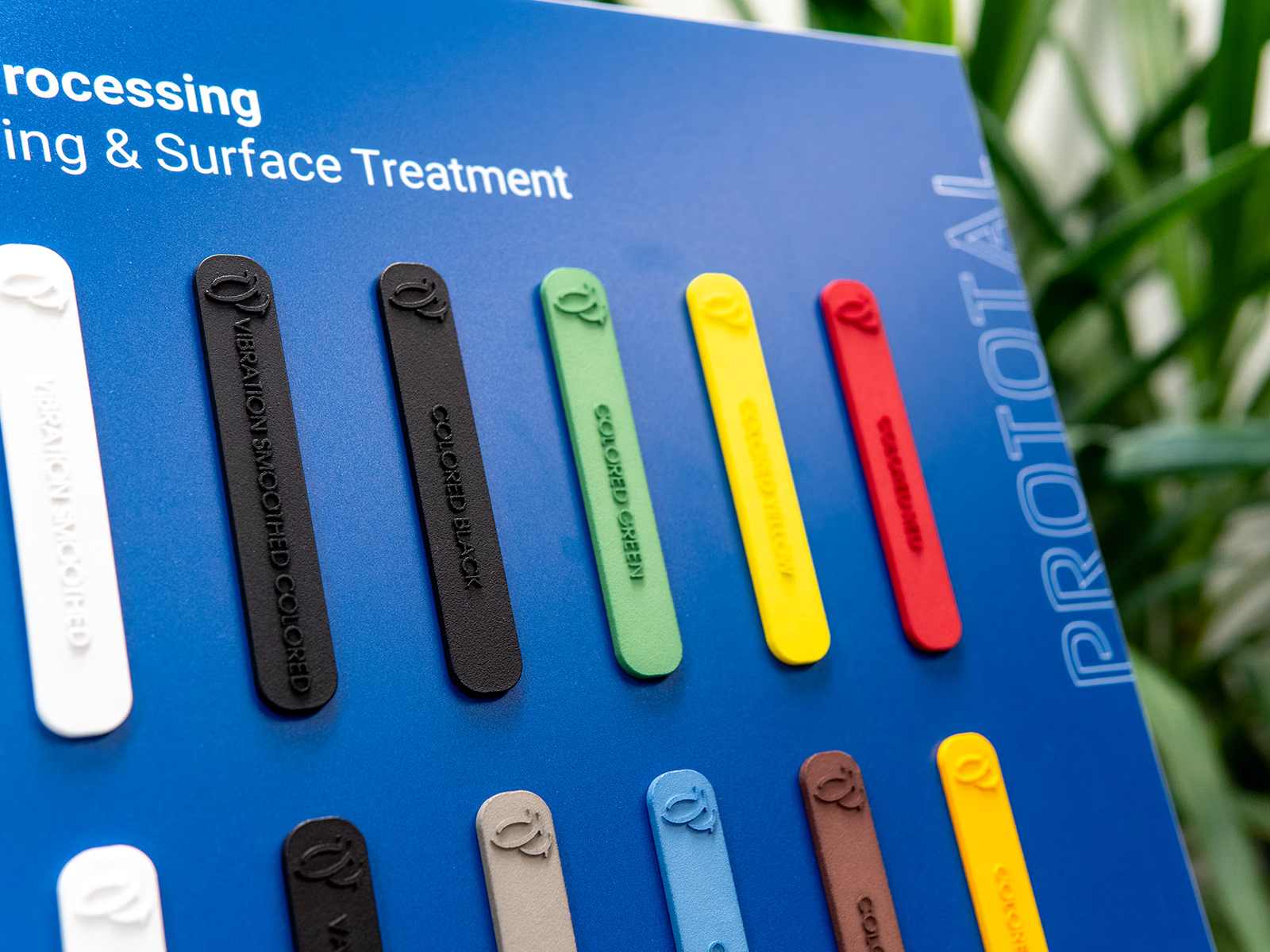
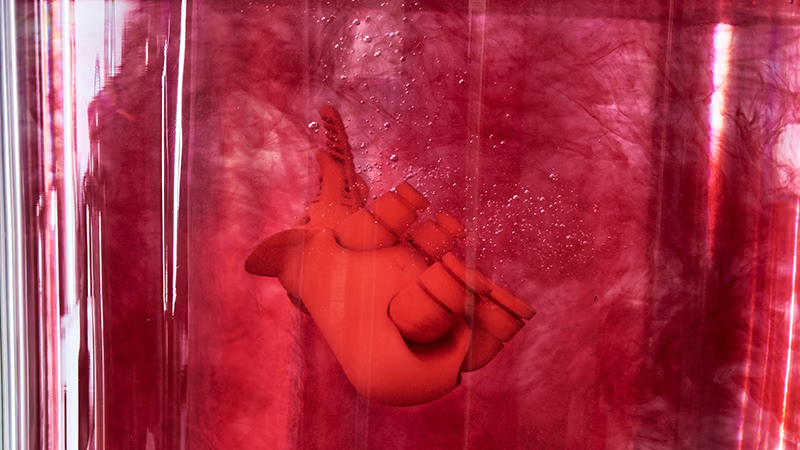
Unlike traditional painting, DDC process uses molecular penetration under heat and pressure to color the parts, which give scratch-resistant, vibrant finish that penetrates up to 200 microns into the surface. Because the dye soaks into the surface rather than sitting on top of it, color vibrancy is preserved even across fine details and textured areas that a spray printing process would struggle to coat evenly. With DDC you can access to over 170 RAL and standardized colors, with the ability to create custom “color-to-match” tones for your specific brand.
Coloring is powered by

Coloring at a Glance
| Feature | Prototal Coloring Capability | Benefit |
|---|---|---|
| Technology | DyeMansion DeepDye Coloring | Industrial-grade batch repeatability |
| Color Depth | Molecular Penetration (0.2 mm on SLS PA 2200) | Scratch-resistant finish |
| Color Range | 170+ RAL Colors & Custom Tones | Exact brand identity matching |
| Maximum Part Size (Ø x H) | 390 x 360 mm | Uniform color for large-scale components |
| Compatible Technologies | MJF, SLS, SAF* & FDR | Optimized for Powder Bed Fusion polymers |
| Compatible Post-Processing | Vibratory Finishing, Bead Blasting & Vapor Smoothing | Optimized most post-processing technologies |
| Biocompatibility | Certified Dyeing Options | Skin-safe for wearables & med-tech |
For vibrant or specific color matching, lighter base materials (such as SLS PA 2200 or MJF PA 12 W) are recommended as they provide a neutral canvas for the DyeMansion process. Final color depth can also vary with part geometry and wall thickness. Darker base materials, such as MJF PA 12, are natively suited for high-quality Black Dyeing.
Quote Your Next Project
Looking for high-quality industrial 3D printing solutions tailored to your needs? Our team is ready to provide a detailed quote for your project. Simply share your specifications, and we’ll deliver a clear, competitive estimate — no surprises, just precision and reliability.
Why choose us?
- 3D printing solutions for any scale and complexity
- Fast and accurate quoting process
- Local presence close to your business and business needs
FAQs
Whether you are navigating the transition from prototyping to serial production or optimizing an existing supply chain, we are here to provide the technical clarity you need. These answers address the most common considerations for industrial-scale 3D printing. If your specific challenge isn’t covered here, our application engineers are ready to discuss your project’s unique requirements and help you find the most efficient path to production.
We use the DyeMansion DeepDye Coloring process for our powder-bed polymers. Unlike painting, this process uses molecular penetration to reach depths of up to 200 microns (measured on SLS PA 2200). This results in a scratch-resistant finish that won’t chip or peel, making it suitable for high-use industrial components and consumer wearables.
Yes. Through the DyeMansion system, we can match over 170 RAL colors and offer custom color-matching for Pantone and NCS systems. We ensure batch-to-batch consistency so that every part in your serial run looks identical.
Standard dye coloring is not UV stable, but we offer specialized coatings for applications requiring long-term light resistance.
While our DyeMansion molecular dyeing provides a vibrant and scratch-resistant finish, the organic pigments used in the process can fade over time when exposed to direct sunlight or intense UV radiation. For parts intended for outdoor use or prolonged light exposure, we recommend the following:
- UV-Protective Clear Coats: We can apply a professional-grade, UV-resistant clear lacquer over the dyed surface to act as a shield, significantly extending the color’s life.
- Industrial Spray Coating (Painting): For maximum durability, we offer high-quality automotive-grade painting in specific RAL or Pantone colors. These coatings are natively UV-stable and provide the best protection against both sunlight and harsh weather conditions.
If your project requires a specific color to remain consistent in an outdoor environment, please let our team know, and we will help you select the most durable finishing strategy.
By utilizing the DyeMansion DDC with standardized color recipes and digital process control, we ensure industry-leading repeatability. While minor variations can occur due to different raw material batches, our automated workflow is designed to deliver consistent results across multiple production runs and into full mass production, making it a reliable solution for serial manufacturing.
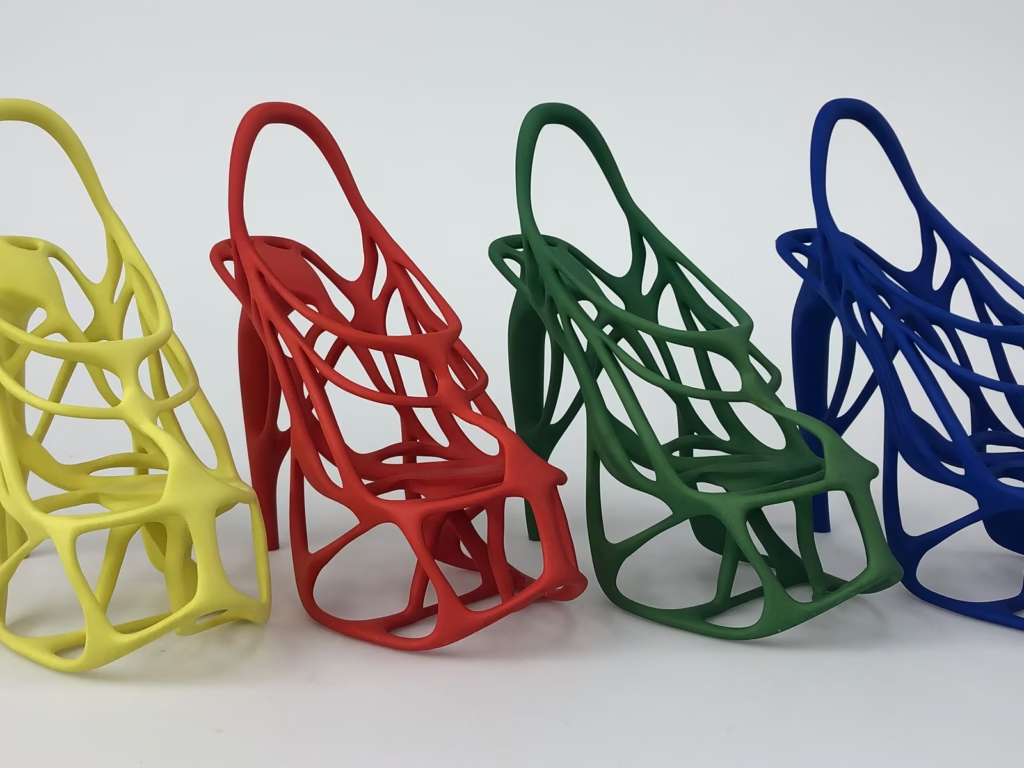
Yes, through our automated dyeing systems. Unlike manual spray painting, which is limited by “line-of-sight,” the DDC process involves total immersion in a pressurized, heated bath. This ensures that the dye reaches every internal surface, lattice internal structures, and complex undercut, coating even the most intricate details for a 100% uniform finish regardless of geometric complexity.
Our DyeMansion DDC process has a negligible impact on part dimensions, making it ideal for high-precision components. Scientific testing show that the dye molecules occupy the microscopic voids within the polymer structure. It does not add a measurable physical layer to the surface.
For Industrial Spray Coating (Painting), a thin layer of primer and lacquer is added to the surface. If your part has extremely tight tolerances or interlocking assemblies, please notify us during the quoting stage so we can account for the coating thickness or mask critical areas.
We generally do not recommend coloring for SLA or DLP parts, but we can accommodate special requests for prototyping purposes. Unlike Powder Bed technologies (MJF and SLS) which have a porous structure ideal for molecular dyeing, SLA and DLP resins are high-density thermoset polymers. This means:
- Surface-Only Adhesion: Dyes cannot penetrate the material deeply; the color remains on the surface and is susceptible to scratching or wear.
- Material Integrity: The chemical baths used in automated dyeing can sometimes affect the mechanical properties or dimensional stability of high-precision resins.
- Alternative Solutions: For professional-grade aesthetics on SLA/DLP parts, we typically recommend industrial spray coating (painting). This provides a durable, UV-stable finish and allows for exact RAL or Pantone matching.
If you require a specific color for a one-off prototype and are aware of these limitations, our team can perform a custom run to help you achieve the desired visual result.
Due to the low surface energy and chemical inertness of Polypropylene, standard dyes cannot penetrate the material. This results in uneven surface coverage and poor adhesion. We recommend using SAF PP in its natural state (dark grey) for applications requiring maximum chemical resistance or liquid handling.


