Industrial Vibratory Finishing for Smooth, High-End Surfaces
Transform the raw texture of 3D printed polymers into smooth and matte finishes. Our automated mass finishing solutions ensure uniform surface quality across entire production batches.

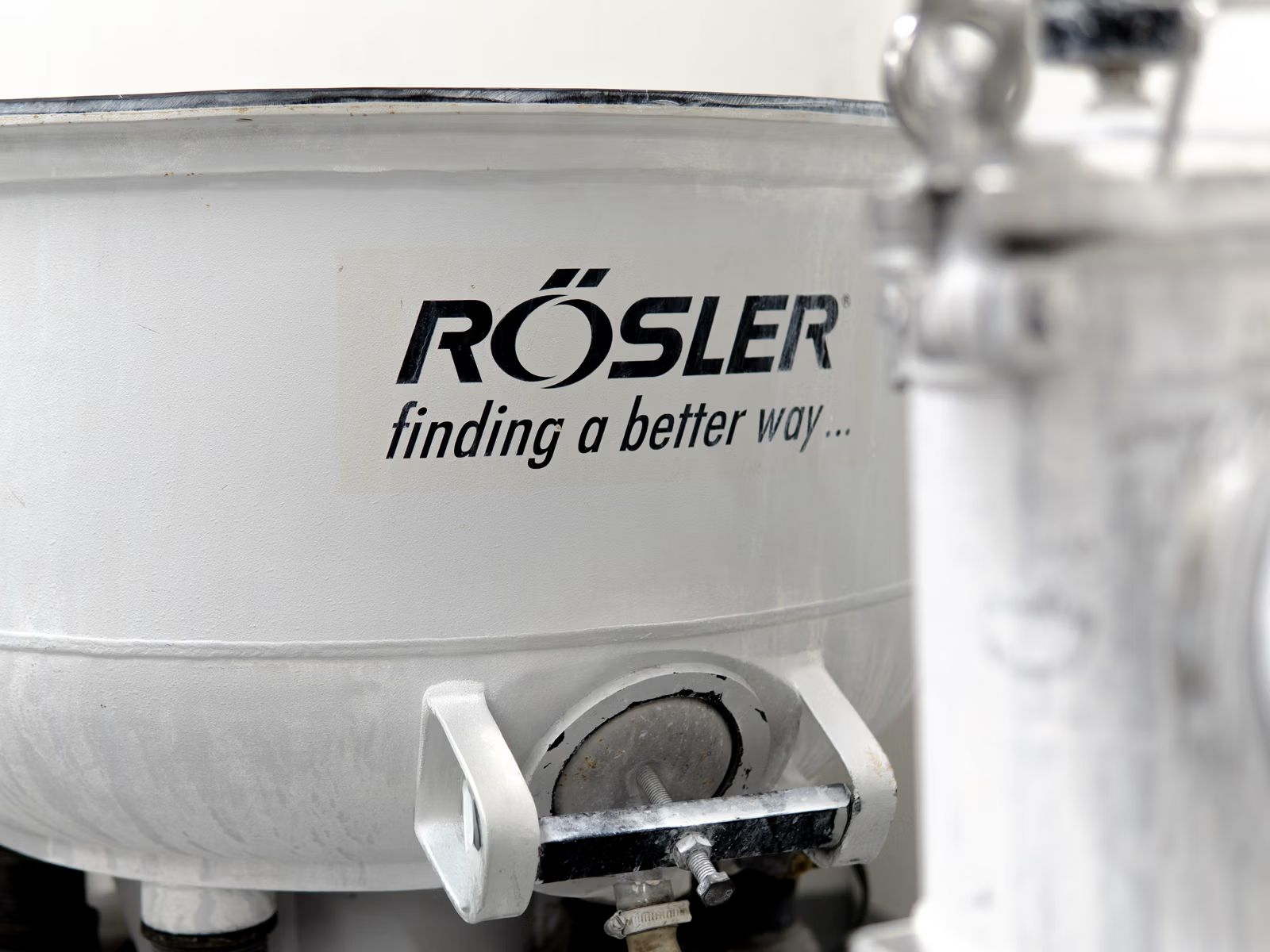
Vibratory Finishing is Powered by

What is Vibratory Finishing?
Parts are placed in a vibrating bowl or tub filled with specialized abrasive media and cleaning agents. The friction between the media and the parts gently “scubs” the surface. The result is a homogenized surface that redue the “stair-stepping” effect of 3D printing, reduces surface roughness, and prepares the part for secondary processes like dyecoloring.
Improved Fatigue Life
Vibratory finishing improves mechanical integrity by smoothing the surface, transitioning the surface from a “jagged” profile to a “wavy” or flat profile. This allows mechanical stress to flow across the surface of the part.
Tactile Quality
Raw Powder Bed Fusion prints have a “sandpaper” or “stony” texture due to the nature of the manufacturing process. Vibratory finishing uses abrasive media to wear down these microscopic peaks. The Benefit is that it eliminates the “dusty” sensation often associated with raw 3D printed parts, making the surface of the parts move from a harsh, porous feel to a smooth, matte texture.
Vibratory Finishing at a Glance
| Feature | Prototal Vibratory Finishing Capability | Benefit |
|---|---|---|
| Primary Goal | Surface Smoothing & Deburring | Decrease Surface Roughness |
| Surface Roughness | Ra 2-5 µm | Achieves a smooth, uniform tactile finish |
| Compatible Technologies | MJF, SLS & SAF | Optimized for Powder Bed Fusion polymers |
| Compatible Post-Processing | DeepDye Coloring | Ensures superior dye intake and finish |
| Maximal Part Size | 700 x 200 x 200 mm | Uniformity for small & large parts |
| Batch Capacity | High-volume mass finishing | Cost-effective for serial production |
| Dimensional Impact | Controlled Rösler Technology at 0.02 – 0.05 mm | Documented dimensional impact |
All documented Ra values and dimensional impacts are based on standard benchmarks for PA 12 (MJF/SLS) materials using AM Solutions. Actual results may vary depending on part geometry, orientation, and base material density. The documented dimensional offset of 0.02 – 0.05 mm is an average; for components with critical tolerances or interlocking features, we recommend a technical consultation or a first-article test to ensure functional requirements are met. Maximal Part Size is dependable on part geometry.

The Perfect Pair
For the highest quality finish, we recommend combining Vibratory Finishing with Dyecoloring. By first smoothing the part in our vibratory bowls, we remove the “peaks” of the raw 3D print. This allows the dye to penetrate more evenly, resulting in a deeper, more vibrant color with a haptic feel.
Quote Your Next Project
Looking for high-quality industrial 3D printing solutions tailored to your needs? Our team is ready to provide a detailed quote for your project. Simply share your specifications, and we’ll deliver a clear, competitive estimate — no surprises, just precision and reliability.
Why choose us?
- 3D printing solutions for any scale and complexity
- Fast and accurate quoting process
- Local presence close to your business and business needs

FAQs
Still got questions? Please visit our dedicated FAQ page for more information about our company and services.
Using our AM Solutions systems, we can reduce the surface roughness Ra of materials like MJF PA 12 or SLS PA 2200 from a raw state of ~20 µm down to below 2 µm.
The “fail-safe” limit is determined by media access. To ensure a surface is finished, the abrasive media must be able to circulate freely against it.
- Internal Cavities & Holes: If a hole or channel is smaller than the abrasive media (typically < Ø 13.5 mm), the media will not enter. These internal areas will remain in their raw, “as-printed” state.
- Media Lodging: We avoid finishing parts where internal features are the exact same size as the media, as this can cause the media to become “lodged” or stuck inside the part.
- Fine Details: While the process is gentle, extremely thin walls < 1.0 mm or sharp, needle-like points may be slightly rounded during the process.
If your part has complex internal lattices or tiny fluid channels that require a smooth finish, we recommend Vapor Smoothing as an alternative post-processing method.


