Vapor Smoothing for Industrial Polymers
Elevate your Powder Bed Fusion parts (SLS, FDR & MJF) with an advanced surface refinement process. Achieve a fully sealed, injection molded aesthetic that enhances hygiene and performance through controlled molecular smoothing.

Vapor Smoothing is Powered by


What is Vapor Smoothing?
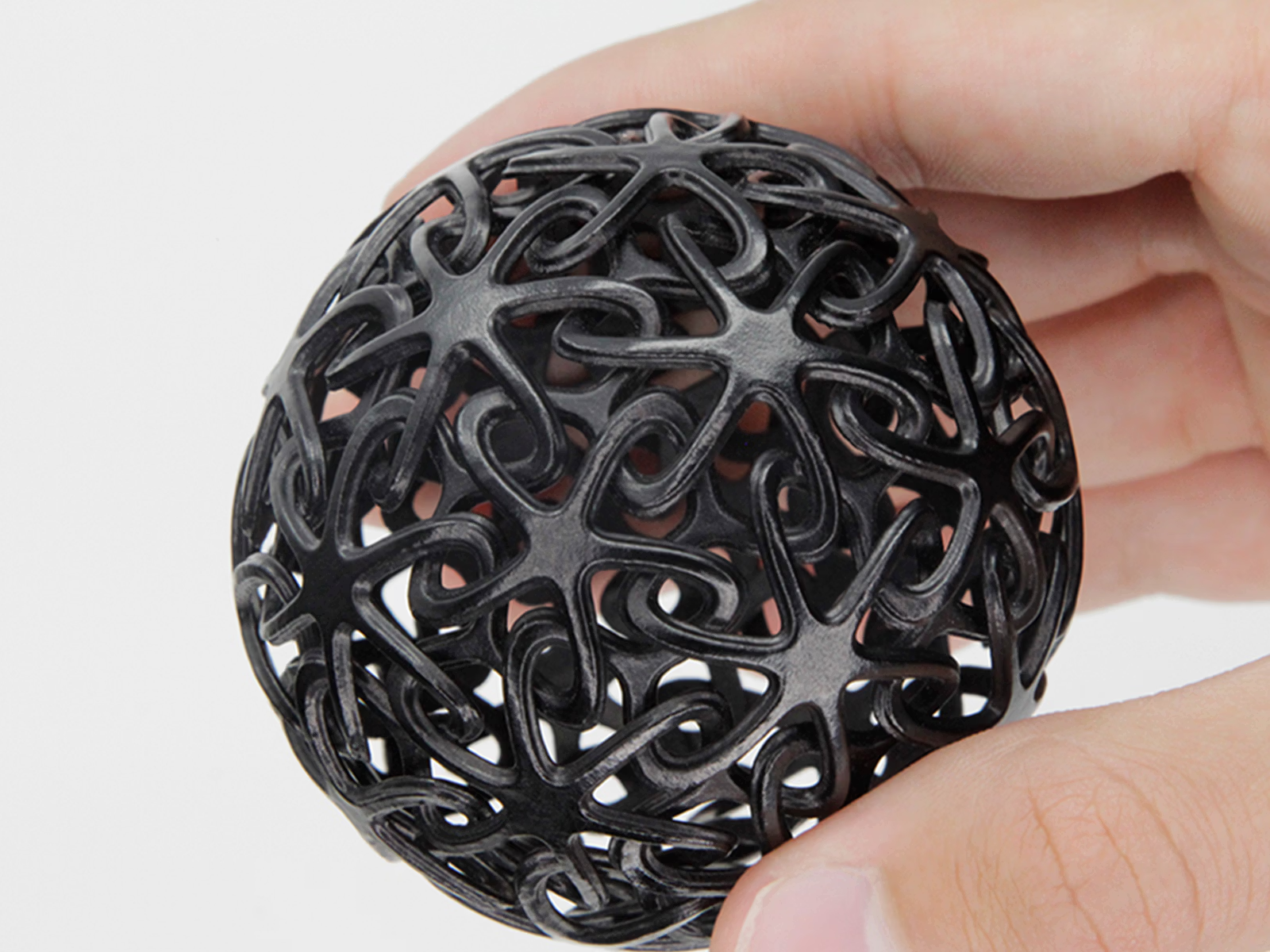
Parts are placed in a controlled vacuum chamber where a specialized vaporized agent circulates. This agent interacts with the outer “skin” of the polymer, allowing the surface material to redistribute and flow into the microscopic “valleys” of the part. A perfectly sealed surface that is both smooth and semi-glossy. Because this is a gaseous process, it reaches every internal channel and complex lattice structure with total uniformity.
Fluid and Airtight Sealing
By fusing the surface pores, parts become naturally waterproof and airtight —the gold standard for manifolds, tanks, and ducting.
Enhanced Hygiene
By removing the surface porosity, bacteria and contaminants have no place to harbor. This makes the process essential for Medical and Food-Contact applications.
Mechanical Ductility
The vapor-phase refinement can improve elongation-at-break, making parts slightly more flexible and resilient compared to raw prints.
Internal Channel Refining
Unlike mechanical finishing, the gas reaches deep inside complex internal geometries that physical media cannot touch.
Vapor Smoothing at a Glance
| Feature | Prototal Vapor Smooting Capability | Benefit |
|---|---|---|
| Primary Goal | Surface Sealing & Smoothing | Creates fluid-tight, airtight parts |
| Surface Roughness | Ra < 1 µm | Achieves a high-gloss, premium finish |
| Compatible Technologies | MJF, SLS & FDR | Optimized for Powder Bed Fusion polymers |
| Compatible Post-Processing | DeepDye Coloring | Ensures superior dye intake and glossy finish |
| Maximal Part Size | 385 x 585 x 385 mm | Uniformity for small & large parts |
| Geometry Access | 100% | Smooths complex internal lattices |
| Dimensional Impact | Zero Material Removal | Maintains mass and structural integrity |
Surface roughness and dimensional impacts are based on standard industrial benchmarks for SLS PA 2200 & MJF PA 12 materials. It is important to note that final results are highly dependent on part geometry and wall thickness. For elastomeric materials such as SLS TPU, the vapor-phase process can lead to a more pronounced dimensional shrinkage compared to rigid polymers. Maximal part size is dependable on geometry.
The Ultimate Duo
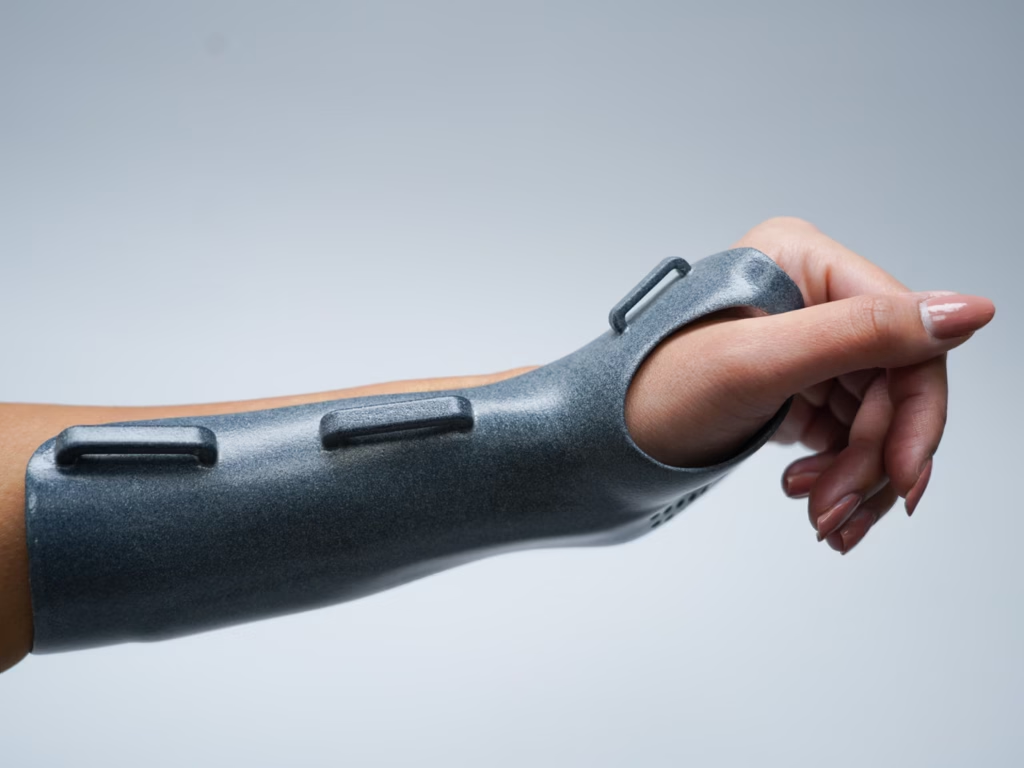
For projects where aesthetic appeal and functional performance are equally critical, combining DeepDye Coloring and Vapor Smoothing delivers a result that is indistinguishable from traditional manufacturing.
While DeepDye Coloring provides rich, consistent color, the Vapor Smoothing process acts as the ultimate “amplifier.” By sealing the surface and reducing roughness to sub-micron levels before or after the coloring stage, we achieve:
- Vibrant Color Depth: The smoothing of the surface allows light to reflect more uniformly, making dyed colors appear deeper, richer, and more saturated.
- A High-Gloss Luster: Unlike the standard matte finish of 3D prints, this pairing creates a semi-gloss or high-gloss appearance that mimics the “piano-black” or polished look of high-end consumer electronics.
- Total Encapsulation: The color is not just on the surface — it is locked within a sealed, low-friction skin that is exceptionally resistant to environmental wear.
Quote Your Next Project
Looking for high-quality industrial 3D printing solutions tailored to your needs? Our team is ready to provide a detailed quote for your project. Simply share your specifications, and we’ll deliver a clear, competitive estimate — no surprises, just precision and reliability.
Why choose us?
- 3D printing solutions for any scale and complexity
- Fast and accurate quoting process
- Local presence close to your business and business needs

FAQs
Whether you are navigating the transition from prototyping to serial production or optimizing an existing supply chain, we are here to provide the technical clarity you need. If your specific challenge isn’t covered here, our application engineers are ready to discuss your project’s unique requirements and help you find the most efficient path to production.
Dimensional change is negligible (typically < 0.01 mm) because this is not a subtractive process; no material is removed. Instead, the surface is redistributed. For elastomeric materials such as SLS TPU, the vapor-phase process can lead to a more pronounced dimensional shrinkage compared to rigid polymers.
Raw 3D printed polymers are naturally porous. The vapor smoothing process “fuses” these surface pores, creating a fully sealed barrier. This makes components airtight and fluid-tight, which is essential for low-to-medium pressure ducting and liquid-handling systems.
Yes. Our process is fully automated and industrial. Any agents used are completely removed during the final vacuum-drying phase, leaving the parts clean, odorless, and certified for skin contact or specialized medical use. It also enhances hygiene by removing the surface porosity where bacteria can harbor.
Absolutely. While Black is our most requested high-gloss finish, the combination of DeepDye Coloring and vapor smoothing refinement works across the entire color spectrum. The smoothing allows light to reflect more uniformly, significantly deepening the color saturation and providing a premium luster.
Vibratory finishing is a mechanical, subtractive process that results in a smooth, matte soft-touch feel. Vapor Smoothing is a non-subtractive gaseous process that results in a sealed, glossy finish and is the only way to effectively treat complex internal lattices and channels.


