
Development, speed, and acceleration are words that perfectly describe the exclusive 2018 Ford GT recently acquired by Danish racing driver Jason Watt. A tailored 3D-printing solution from Prototal improved the exclusive race car—and here, too, development, speed, and acceleration are the perfect fit.
- 3D printing provides fast access to tailored spare parts.
- Prototal’s experts delivered the finished product in just 14 days.
For most manufacturers of mass-produced items, consumer suggestions for innovation and adjustments are impossible to accommodate in practice. This is because car production, like much of industrial manufacturing, is based on large-scale assembly line principles. A complex number of components must be integrated into the overall solution before the finished model rolls out of the factory gates.
However, 3D printing is revolutionizing the possibilities for creating customized solutions. Here, small batches and tailored options are the very core. 3D printing technology is advancing rapidly, and there are no limits to what can be manufactured.
When executed in the right material, with the necessary know-how, and on the right advanced equipment, 3D printing allows for the production of parts at the required quality level. Jason Watt discovered this firsthand. He frequently uses his metallic green Ford GT 2018 for charitable purposes under the auspices of Sport Car Event. Annually, he gives several thousand people the opportunity to realize their dreams of riding in special cars, raising funds for the Danish Childhood Cancer Foundation (Børnecancerfonden)
Worn Components Can Be Replaced with 3D Printing
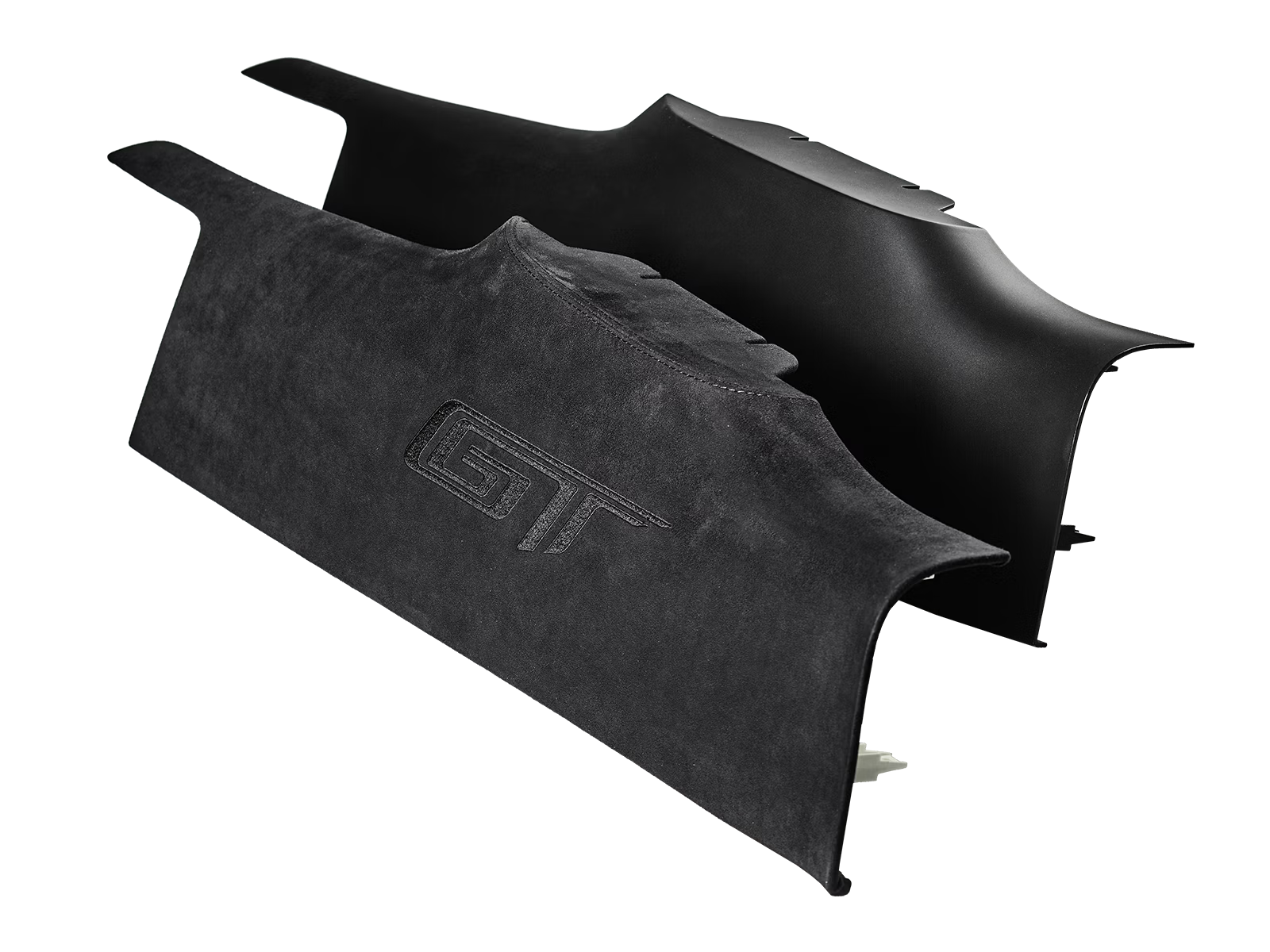
By nature, a race car is aerodynamic and low, making it difficult to get in and out of. The Canadian-built Ford GT comes with door sill panels made of Alcantara-covered plastic. With more than 1,000 people entering and exiting the car annually, footprints would quickly appear on the door sills, and the car’s interior would soon show signs of wear.
Jason Watt investigated the possibility of buying extra panels for the Ford, but to no avail. Then, he received a tip from a colleague: “I think I know someone who can 3D-print the panels.”
“My first reaction was a laugh of dismissal. You can’t do that! The plastic plates have a very specific shape and a unique ribbed structure. I considered it impossible to 3D-print a solution with the look and quality that was essential.”
“Despite knowing a lot about cars, I hadn’t seen 3D printing as a solution. But today, 3D printing technology has come much further than I ever thought possible. There is enormous potential for more people to benefit from 3D-printed solutions: with 3D printing, spare parts and gadgets can be produced quickly, cheaply, and in the necessary quality,” says Jason Watt.
He decided to put it to the test and sent the panel to Prototal, one of Northern Europe’s most experienced experts in 3D printing. The answer from Prototal was clear:
“No problem. We can easily 3D-print that.”
From there, things moved quickly. Prototal’s experts handled the entire process, and within just 14 days, Jason Watt had the solution he wanted.
“Prototal’s solution is of impressively high quality and completely identical to the original parts from Ford. I had the panels covered in Alcantara and even had a Ford GT logo embroidered into the panel through the close quality-collaboration Prototal has with its subcontractors. Thus, Prototal’s solution ensured that I ended up with an even more valuable car than I had before. Good and close cooperation simply resulted in an even better model,” says Jason Watt.


