SLA 3D Printing Service: Large-Scale Precision for Industrial Prototypes
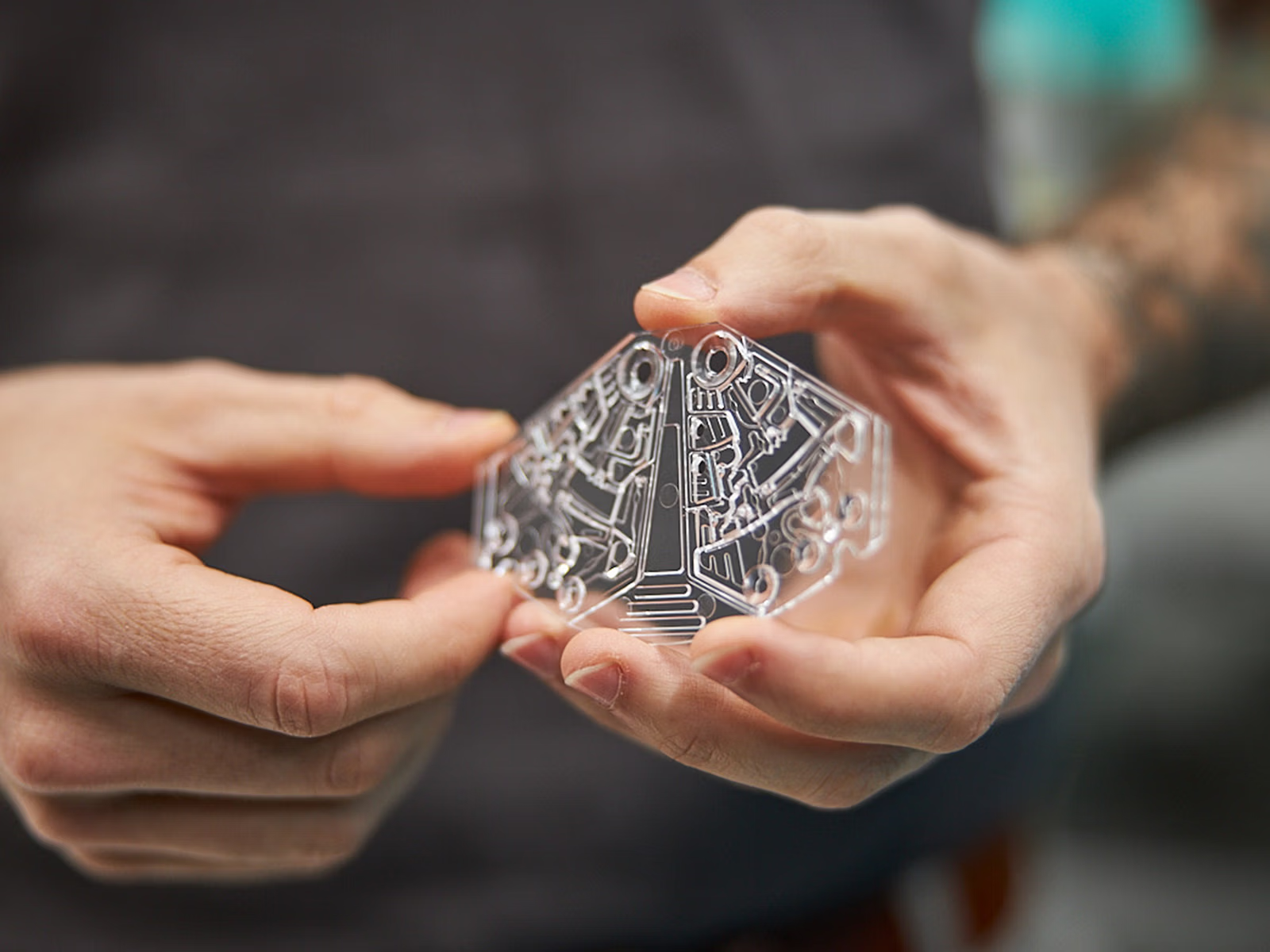
Stereolithography (SLA) remains the industry standard for creating large, highly detailed components with a smooth surface finish that mimics injection molding. At Prototal, our industrial SLA 3D Printing capabilities allow for the production of massive, monolithic parts that other resin-based technologies simply cannot match.
Whether you are developing complex automotive housings, architectural concept models, or master patterns for vacuum casting, SLA provides the perfect balance of scale, dimensional accuracy, and aesthetic excellence – making it equally suited for early-stage visual prototypes and engineering-grade functional prototypes.

Powered by


| Feature | Prototal SLA Capability | Benefit |
|---|---|---|
| Max Build Volume | 1500 x 750 x 550 mm | Large-scale, single-piece production |
| Specialized Materials | Accura (ClearVue, Xtreme, 25, HPC) & Somos WaterClear Ultra | Tailored mechanical and optical properties |
| Accuracy | Industrial tolerances down to 0.1 mm | High precision models & prototypes |
| Surface Finish Capability | Ultra smooth | Ideal for polishing, painting, plating, and/or clear coating |
Large-Scale Precision for Industrial Prototypes
SLA technology remains the gold standard for producing large, highly detailed components with a surface finish that rivals injection molding. As a mature additive manufacturing process, it utilizes industrial-grade ultraviolet lasers to cure liquid resin, achieving exceptional dimensional accuracy and isotropic mechanical properties across a massive build volume. For projects with tight tolerance requirements, this combination of precision and consistency is what makes SLA stand apart from other polymer technologies.
Industries benefiting from SLA:
- Automotive: Full-scale dashboards, interior trim, and high-fidelity aerodynamic models for wind tunnel testing
- Fashion: High-aesthetic look-and-feel models and crystal-clear housings
- Aerospace: Large-scale structural models and specialized ducting requiring smooth internal surfaces
Mastering the Build Envelope
While other resin technologies are limited by platform size, our industrial SLA systems offer a massive build volume of up to 1500 x 750 x 550 mm. This allows engineers to produce large, monolithic structures as a single piece, eliminating the structural weaknesses and labor costs associated with sectioning and bonding multiple parts. For teams working in rapid prototyping, this also means fewer iterations are needed to validate large assemblies.
The Gold Standard for Finishing
SLA parts are characterised by their smooth, non-porous surface finish and high feature resolution. This makes SLA the preferred foundation for secondary processes. Whether your project requires automotive-grade painting, metal plating, or optical polishing, SLA can deliver high-end aesthetic models.
Optical Clarity and Performance
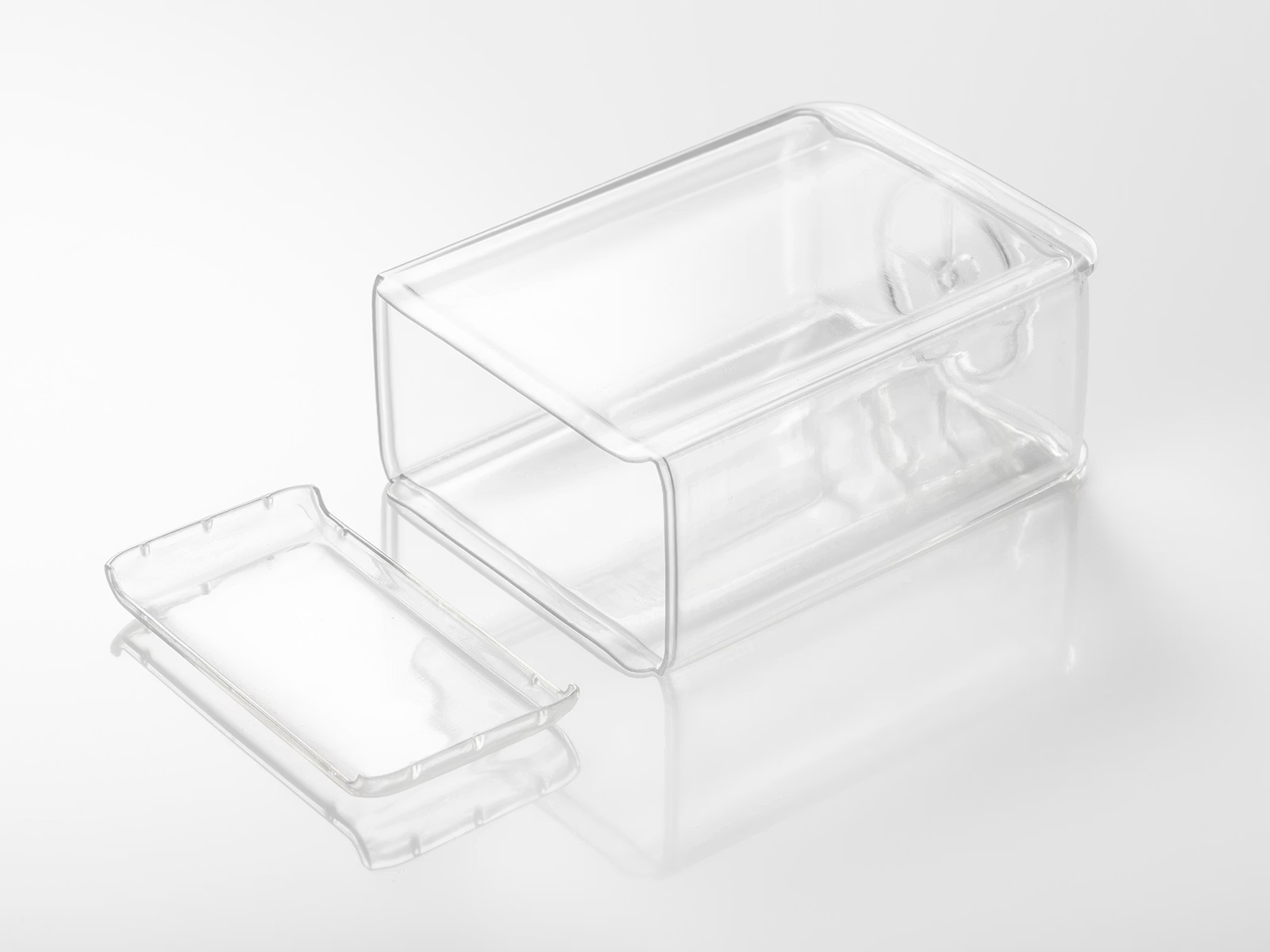
Our portfolio of SLA resins bridges the gap between aesthetics and function. Resins like Accura ClearVue and Somos WaterClear Ultra provide near-glass transparency for lenses and fluid analysis, while Accura Xtreme and Accura 25 offer the toughness and flexibility needed for assemblies. For high-load testing, Accura HPC delivers extreme rigidity and dimensional stability.
European Production Hubs
Prototal offers industrial SLA production across Denmark, Sweden, Austria, and the UK. This regional presence ensures local technical expertise and rapid delivery, providing the scaling power of a global leader with the agility of a local partner.
Datasheets at a Glance
| Stereolitography | Density (g/cm³) | Tensile modulus (MPa) | Elongation at break | HDT (°C @ ~0.45 MPa) | Key Characteristics |
|---|---|---|---|---|---|
| Accura ClearVue | 1.17 | XY 2640 | XY 15% | 51 | High Transparency |
| Accura Xtreme | 1.19 | XY 1980 | XY 22% | 62 | Impact Resistance |
| Accura 25 | 1.19 | XY 1660 | XY 20% | 58 | Polypropylene-like |
| Accura HPC | 1.61 | XY 9700 | XY 1.9% | 73 | Extreme Stiffness |
| Somos WaterClear | 1.13 | XY 2880 | XY 7.5% | 49 | High Transparency |
The data shown is indicative and intended for reference only. Material properties may vary depending on printing conditions and technology. Although care has been taken to ensure accuracy, typographical or data entry errors may occur. Please be aware that certain values in this table can be derived from different testing standards made from our suppliers, for authoritative specifications, please refer to the original manufacturer datasheets provided under each material.

3D Printing Guidelines
Our helpful guides are specifically designed to assist you before submitting your design to us. We always strive to achieve the best possible outcome, and by following our guidelines, you can be confident that your design will be of the highest quality.
Get in touch with us if you need guidance, we are happy to help you!
How SLA Achieve Large-Scale Perfection
The Stereolithography process is a high-precision additive manufacturing technology that uses an ultraviolet (UV) laser to solidify liquid resin, layer by layer, into a solid object.
The Step-by-step Process in SLA
- Digital Orientation & Preparation: Your CAD data is optimized for the large-scale build plate. We strategically place supports to ensure dimensional stability, especially for monolithic parts that utilize the full 1500 x 750 x 550 mm envelope.
- Laser-Induced Polymerization: An industrial-grade UV laser traces the cross-section of the part onto the surface of a vat of liquid photopolymer resin. Where the laser hits the liquid, it instantly solidifies the material with a precision down to 0.1 mm.
- Layer-by-Layer Recoating: The build platform moves down 0.05-0.1 mm (depending on settings), and a recoater blade sweeps across the vat to ensure a perfectly level layer of fresh resin is ready for the next laser pass.
- UV Post-Curing: Once the build is complete, the part is cleaned in a specialized solvent bath to remove excess resin. It then undergoes a final “bake” in a UV oven to ensure the material reaches its full mechanical strength and thermal integrity.
- Industrial Finishing: The part is now ready for high-end post-processing, ranging from support removal and light sanding to optical polishing for materials like Accura ClearVue.
Bring Your Design to Life
"*" indicates required fields
By submitting this form, you agree to our Privacy Policy. We use the information you provide to respond to your inquiry and provide requested manufacturing services.
Quote Your Next Project
Looking for high-quality industrial 3D printing solutions tailored to your needs? Our team is ready to provide a detailed quote for your project. Simply share your specifications, and we’ll deliver a clear, competitive estimate — no surprises, just precision and reliability.
Why choose us?
- 3D printing solutions for any scale and complexity
- Fast and accurate quoting process
- Local presence close to your business and business needs

FAQs
Do you have questions regarding SLA Industrial 3D Printing? Find the most common questions and answers about the subject here.
The primary deciding factor is build volume. While DLP is optimized for high-speed production of small, intricate parts (up to 150 mm), SLA is the definitive choice for large-scale components. With a build envelope of 1500 x 750 x 550 mm, SLA allows for the production of massive, monolithic parts that would otherwise require sectioning and bonding.
Our largest industrial SLA systems allow us to produce single, continuous parts up to 1500 x 750 x 550 mm. Printing large components as a single unit ensures maximum structural integrity and a seamless aesthetic. Please note that while we offer SLA services across Denmark, Sweden, Austria, and the UK, local availability and maximum supported build sizes vary by facility. For projects exceeding the capacity of a specific local site or the maximum monolithic dimensions, our expert team can precisely section and bond multiple SLA components together to create virtually any size required without compromising quality.
Our industrial SLA systems are calibrated for high-precision engineering, offering tolerances down to 0.1 mm. This makes it ideal for complex assemblies, wind tunnel models, and master patterns where dimensional stability is critical across a large surface area.
SLA is the gold standard for high-fidelity prototyping and master patterns due to its surface finish; however, because the resins are UV-curable, they remain sensitive to long-term light and heat exposure. For this reason, we do not recommend SLA for permanent end-use applications where mechanical properties must remain unchanged for years. If your project requires durable, end-use production parts with long-term UV stability and environmental resistance, we recommend our Powder Bed Fusion (PBF) technologies, such as SLS or MJF, which utilize robust engineering thermoplastics like Polyamide.
We offer a range of post-processing services to ensure your 3D printed parts meet the highest standards of quality, precision, and aesthetics.
- Assembly
- Support removal & Sanding
- Coating, painting & lacquering
- Metal plating
- Threaded/non-threaded inserts
Manufacturing should not be transactional. At Prototal we value a partnership, which is why you will get a dedicated contact person close to your operations that knows your business and business needs. To start our future partnership, please reach out to the local team within your area that can be found under Contact us or send us an e-mail:
- Norway: post@prototal.no or +47 74 09 06 00
- Sweden: am@prototal.se or +46 36 38 72 00
- Denmark: 3dp@prototal.dk or +45 43 99 37 36
- United Kingdom: info@prototaluk.com or +44 1635 635855
- Italy: info@prosilas.com or +39 733 892665
- Austria, Germany & Switzerland: 3dp@prototalgroup.at or +43 5572 52946-9
As a flexible partner we can offer lead times down to 1 working day depending on the selection of post-processing and quality control. Usually, you can expect a lead time within the range of 2-3 working days, depending on same variables as stated above.*
*While Prototal offers industry-leading turnaround times, all delivery schedules are estimates based on standard operating conditions. Final lead times are subject to local availability, part geometry, build volume, and specific material selection. Complex geometries requiring extensive support structures or high-performance materials may require additional processing time to ensure structural integrity and dimensional accuracy.


