Industrial Metal 3D Printing Services
Leverage Industrial Metal 3D Printing to accelerate your product lifecycle, from high-fidelity functional prototypes to certified serial production. At Prototal, we specialize in Direct Metal Laser Sintering (DMLS), providing the structural integrity and precision required to bridge the gap between complex engineering designs and high-performance end-use parts.
Utilizing our specialized center of excellence in the UK, Prototal is your partner for realizing complex metal geometries that traditional manufacturing cannot achieve. Our deep-rooted expertise in the demanding motorsport and high-performance vehicle sectors serves as a benchmark for our quality, delivering the tight tolerances and repeatable excellence required by the aerospace, medical, and energy industries.

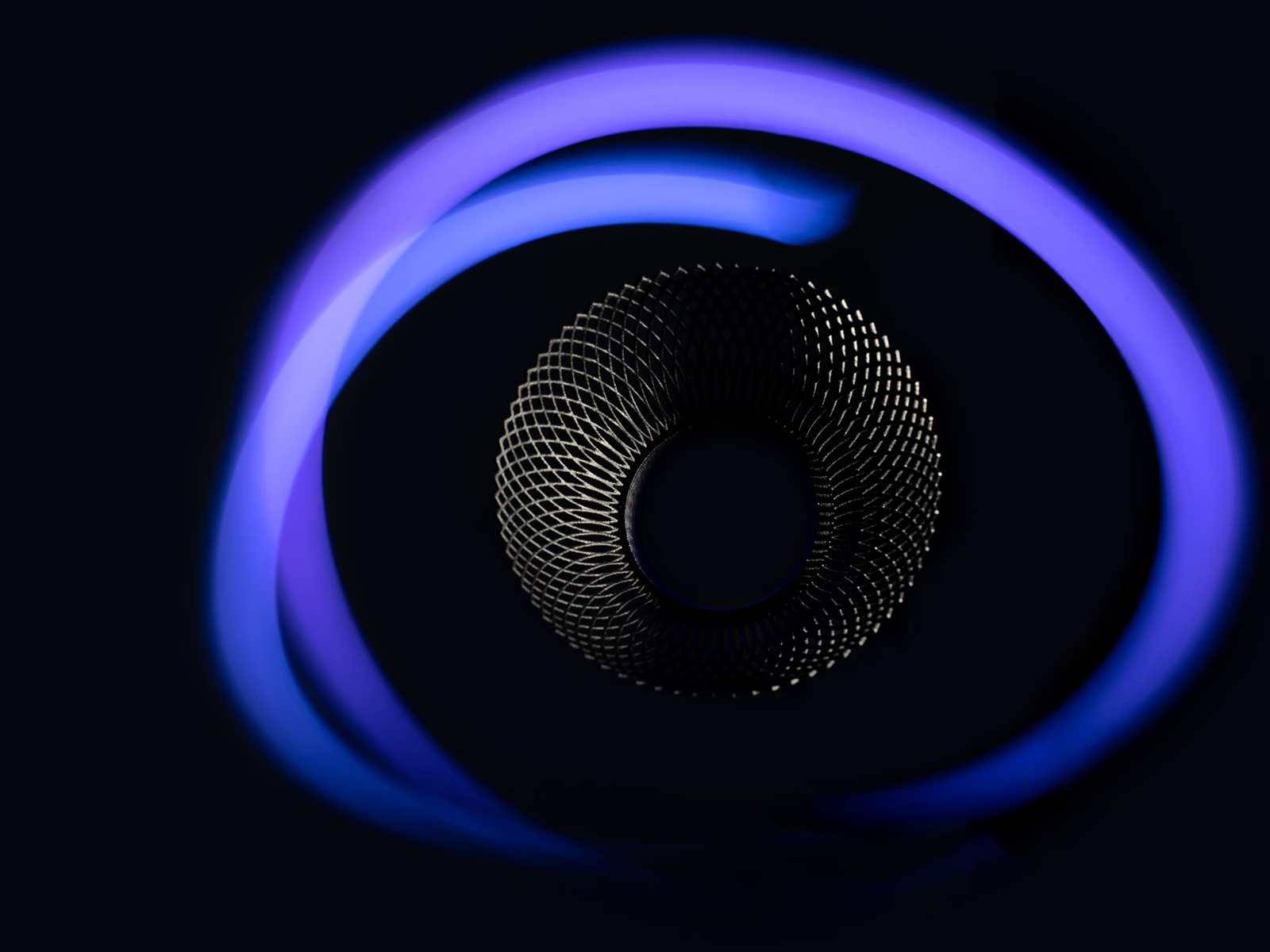
Why Metal 3D Printing?
Traditional manufacturing is defined by constraints like tool access and material waste. Metal 3D Printing transforms complexity into an asset. At Prototal, we provide the industrial infrastructure to bypass traditional limitations, delivering high-performance components that are lighter, stronger, and more thermally efficient.
Geometric Freedom & Part Consolidation
Metal 3D Printing enables Complexity for Free. We merge multi-component assemblies into single, seamless parts, eliminating fasteners, welds, and seals. This streamlines your Bill of Materials (BOM) and removes potential failure points for a more robust industrial result.
Rapid Iteration & Zero-Tooling Entry
By removing the need for specialized casting molds or CNC fixtures, we move from CAD to high-performance metal parts in days. This agility allows for real-world design refinement without the financial penalty of tooling modifications.
Advanced Thermal Management
We integrate conformal cooling channels that follow the internal contours of a part, optimizing heat transfer in ways straight-line drilling cannot. This is the definitive solution for high-performance molds and heat exchangers.
Lightweighting & Material Efficiency
Using internal lattice structures and generative design, we significantly reduce part weight while maintaining structural integrity. This “Material where you need it” approach ensures maximum yield for industries where every gram impact efficiency i.e. in the world of Motorsport.
Digital Supply Chain Resilience
Metal 3D printing transforms physical inventory into a digital library. We produce specialized or legacy parts on demand, reducing warehousing costs and mitigating supply chain disruptions by eliminating the need for mass-produced safety stock.
Our Material Selection for Metal
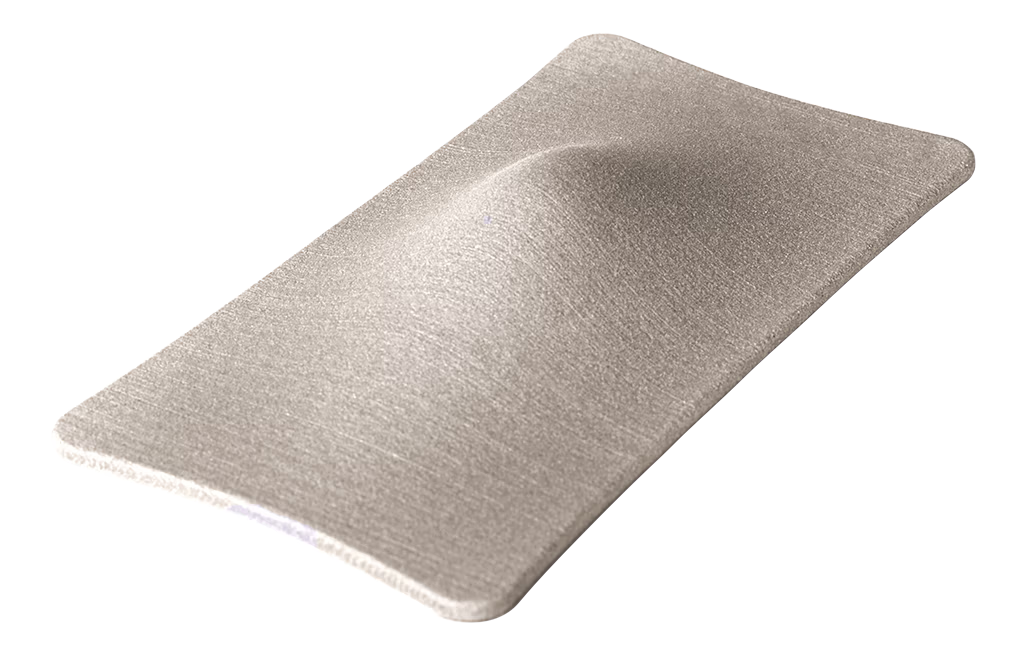
Titanium Ti6Al4v grade 23
Engineered for the most demanding environments, this high-strength alloy combines extreme durability with low density, offering a biocompatible and heat-resistant solution for aerospace and medical applications.
- High-purity grade 23 Titanium alloy
- Excellent strength-to-weight ratio
- High corrosion & fatigue resistance
- Biocompatible

Aluminium AlSi10Mg
This race-proven alloy offers exceptional thermal conductivity and strength-to-weight ratios, providing a lightweight, corrosion-resistant metal solution for high-performance structural and thermal management components.
- Good strength-to-weight ratio
- Good strength up to around 200°C
- High corrosion resistance
- Good thermal and electrical conductivity
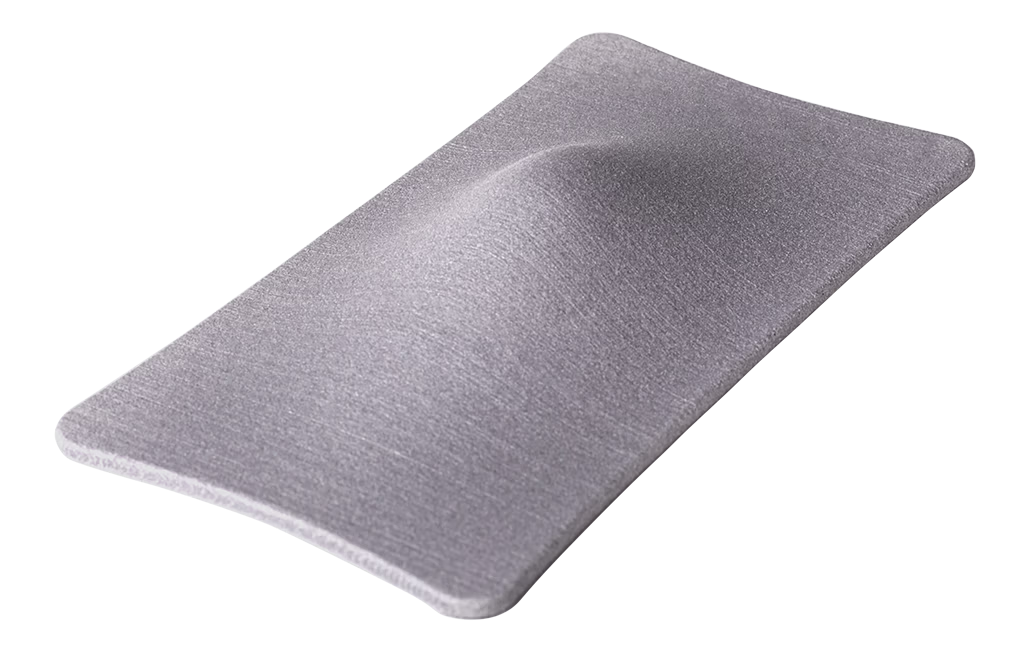
Stainless Steel 316L*
This industrial-grade alloy provides superior corrosion resistance and excellent mechanical properties, delivering a rugged and versatile metal solution for complex components in the marine, chemical, and food processing industries.
- Excellent corrosion and oxidation resistance
- High ductility and impact strength
- Superior chemical and acid resistance
- Biocompatible
*Subcontracted material
Four decades in the industry have taught us one thing: there is no substitute for experience.
Our transition into Metal 3D Printing wasn’t based on a trend, but on a deep understanding of material science with nearly 50 years of manufacturing experience.
This long-term perspective is what allows us to push the boundaries of part consolidation and thermal management today.
— Gregory Campell, Managing Director at CA Models member of Prototal Group

A Trusted Metal 3D Printing Partner
Prototal is more than a service provider; we are a strategic partner with a deep-seated legacy in the British motorsport sector. For decades, our UK-based team has worked at the forefront of elite racing, developing a specialized expertise in precision metal engineering that few can match. This long-standing partnership with the world’s most demanding high-performance vehicle programs has defined our approach to Metal 3D Printing.
In an industry where a fraction of a second is the difference between winning and losing, our reliability and technical rigor are non-negotiable. We treat every project — regardless of the industry, with the same “race-ready” mindset, utilizing our DMLS expertise to deliver components that thrive under extreme mechanical and thermal stress. When you partner with Prototal, you gain access to a heritage of innovation and a proven track record of solving the most complex metal manufacturing challenges with speed, accuracy, and industrial-grade durability.

3D Print Guidelines
Our helpful guides are specifically designed to assist you before submitting your design to us. We always strive to achieve the best possible outcome, and by following our guidelines, you can be confident that your design will be of the highest quality.
Get in touch with us if you need guidance, we are happy to help you!
Datasheets at a Glance
| DMLS | Ultimate Tensile Strength | Yield Strength (Rp 0.2%) | Elongation at break | Hardness (Vickers) | Thermal Conductivity |
|---|---|---|---|---|---|
| Aluminium AlSi10Mg | 330-350 MPa | 220-240 MPa | 5-10% | 100-130 HV | 110-150 W/mK |
| Titanium Ti6Al4v (grade 23) | 1000-1100 MPa | 900-1000 MPa | 10-15% | 300-360 HV | 6.5-7.5 W/mK |
| Stainless Steel 316L* | 550-600 MPa | 450-500 MPa | 30-40% | 200-230 HV | 13-15 W/mK |
The data shown is indicative and intended for reference only. Material properties may vary depending on printing conditions and technology. Although care has been taken to ensure accuracy, typographical or data entry errors may occur. Please be aware that certain values in this table can be derived from different testing standards made from our suppliers, for authoritative specifications, please refer to the original manufacturer datasheets provided under each material. *Subcontracted material.
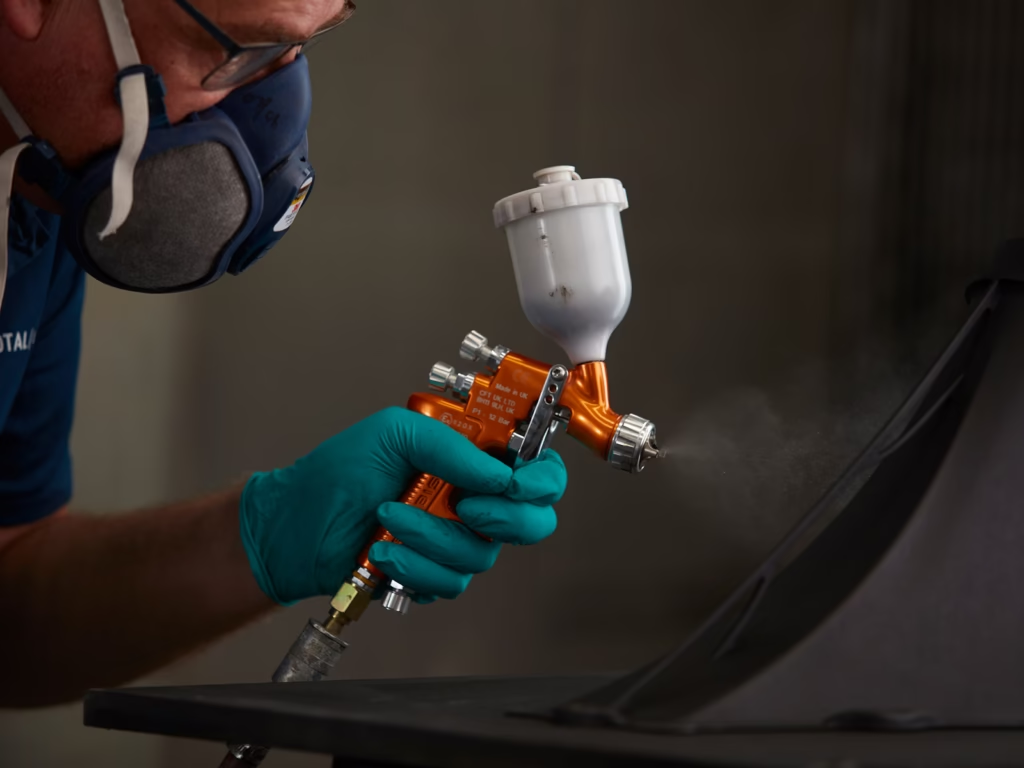
Post-Processing
We offer a range of post-processing services to ensure your metal 3D printed parts meet the highest standards of quality, precision, and aesthetics.
- Heat Treatment
- EDM Wiring & Support Removal
- Dry & Wet blasting
- Vibratory Finishing
- CNC Machining
- Anodizing
- Polishing
- Painting
Quote Your Next Project
Looking for high-quality industrial 3D printing solutions tailored to your needs? Our team is ready to provide a detailed quote for your project. Simply share your specifications, and we’ll deliver a clear, competitive estimate — no surprises, just precision and reliability.
Why choose us?
- 3D printing solutions for any scale and complexity
- Fast and accurate quoting process
- Local presence close to your business and business needs

Bring Your Design to Life
"*" indicates required fields
By submitting this form, you agree to our Privacy Policy. We use the information you provide to respond to your inquiry and provide requested manufacturing services.
FAQs
Do you have questions regarding Industrial 3D Printing in Metal? Find the most common questions and answers about the subject here.
Metal 3D printing is not merely a prototyping tool; it is a transformative manufacturing process that allows engineers to bypass the geometric constraints of CNC machining and casting. The primary advantages include:
- Material Efficiency: Unlike CNC machining, where up to 90% of a block can end up as scrap shavings, DMLS is an additive process. We only use the powder required for the part, making it a more sustainable choice for high-value alloys.Industrial 3D printing, also known as additive manufacturing, offers a wide range of advantages that have made it increasingly popular across various industries. Here are some key advantages of 3D printing:
- Unrivaled Geometric Freedom: DMLS enables the creation of complex internal structures, such as conformal cooling channels in injection molds or lightweight bionic lattices, which are impossible to produce using subtractive methods.
- Part Consolidation: You can merge multi-component assemblies into a single, unified part. This eliminates the need for welding, fasteners, and assembly labor, while significantly reducing potential points of failure and weight.
- Rapid Iteration & Bridge Production: Bypass the high costs and long lead times associated with specialized tooling. Metal 3D printing allows you to move from CAD to a functional, end-use part in high-performance alloys (like Titanium or Inconel) in a fraction of the time.
- Weight Optimization (Topology Optimization): By placing material only where it is structurally required, we can achieve massive weight savings—critical for the aerospace, UAV, and automotive sectors—without compromising the mechanical integrity of the component.
We offer a range of post-processing services to ensure your metal 3D printed parts meet the highest standards of quality, precision, and aesthetics.
- Heat Treatment
- EDM Wiring & Support Removal
- Dry & Wet blasting
- Vibratory Finishing
- CNC Machining
- Anodizing
- Polishing
- Painting
We offer Direct Metal Laser Sintering (DMLS) also known as Selective Laser Melting (SLM) with Nikon SLM
We have a wide range of materials within different technologies. We are always introducing new materials, but right now this is what we offer:
- Aluminium (AlSi10Mg)
- Titanium (Ti6Al4v)
- Stainless Steel 316L*
*Subcontracted material
The maximal size of part printable is dependable on the geometry of your part:
- DMLS – 500x280x365 mm
Manufacturing should not be transactional. At Prototal we value a partnership, which is why you will get a dedicated contact person close to your operations that knows your business and business needs. To start our future partnership, please reach out to the local team within your area that can be found under Contact us or send us an e-mail:
- Norway: post@prototal.no or +47 74 09 06 00
- Sweden: am@prototal.se or +46 36 38 72 00
- Denmark: 3dp@prototal.dk or +45 43 99 37 36
- United Kingdom: info@prototaluk.com or +44 1635 635855
- Italy: info@prosilas.com or +39 733 892665
- Austria, Germany & Switzerland: 3dp@prototalgroup.at or +43 5572 52946-9
As a flexible partner we can offer lead times down to 2 working day depending on the selection of technology, material, post-processing and quality control. Usually, you can expect a lead time within the range of 5-7 working days, depending on same variables as stated above.
*While Prototal offers industry-leading turnaround times, all delivery schedules are estimates based on standard operating conditions. Final lead times are subject to local availability, part geometry, build volume, and specific material selection. Complex geometries requiring extensive support structures or high-performance materials may require additional processing time to ensure structural integrity and dimensional accuracy.


