SAF 3D Printing Service: Industrial-Scale Production with Polypropylene
Selective Absorption Fusion technology (SAF™) is engineered for the rigors of the factory floor and built to meet real production demands. By delivering uniform thermal management across the entire build bed, SAF technology ensures consistent mechanical properties for every part – whether you are printing ten or ten thousand production grade parts.
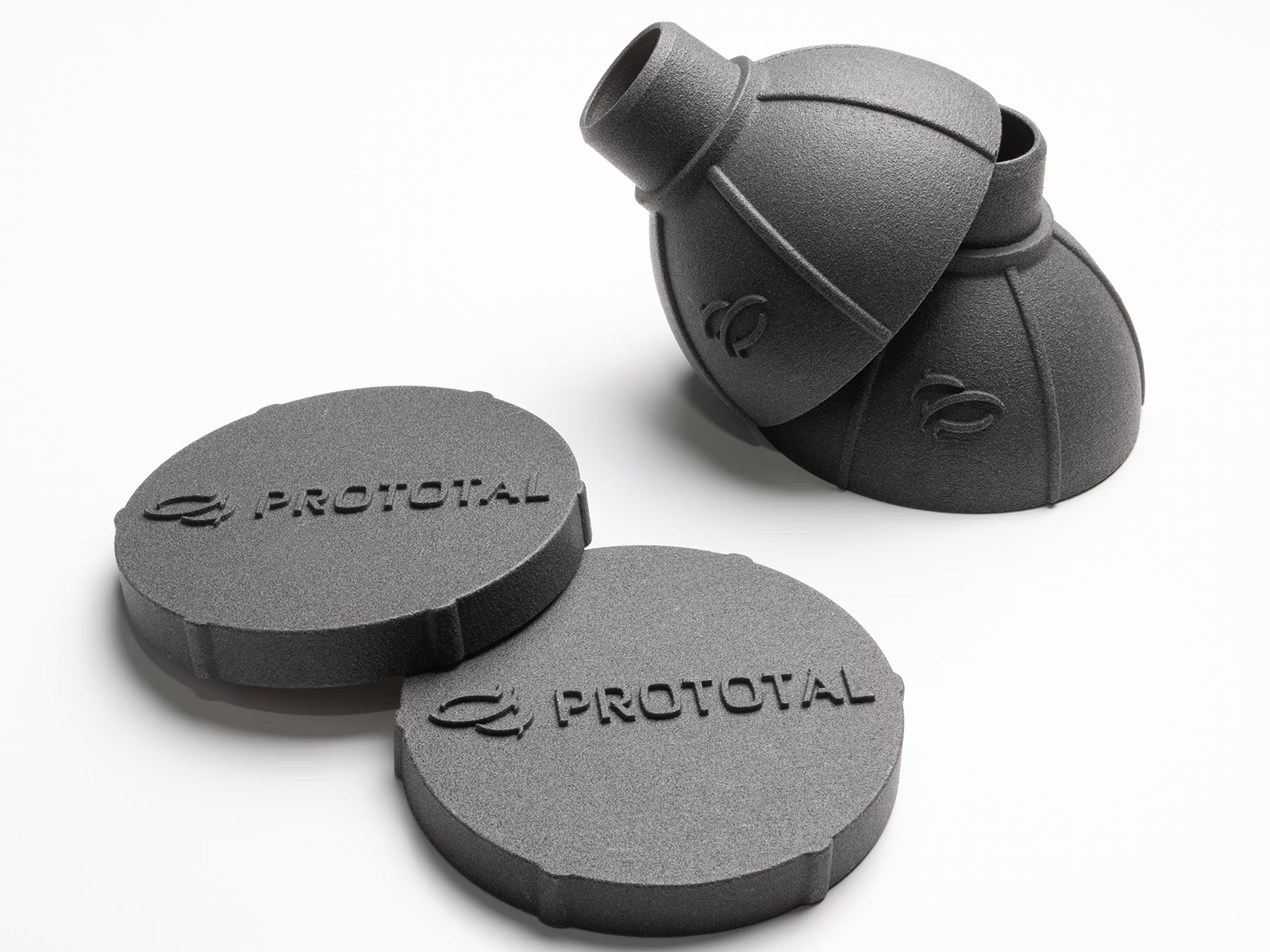
At Prototal, we pair SAF technology with Polypropylene (PP) to provide a production-ready solution for parts that require high chemical resistance, low moisture absorption, and excellent weldability – all delivered at a low cost per part when scaled to volume production.

Powered by

| Feature | Prototal SAF Capability | Benefit |
|---|---|---|
| Max Build Volume | 315 x 208 x 293 mm | Efficient multi-material assembly production |
| Material | Polypropylene (PP) | Chemical resilience & industrial weldability |
| Surface Finish | Matte & Uniform | Ready for end-use industrial applications |
To ensure the highest dimensional accuracy and success rate, we generally advise customers to prioritise organic shapes and curved geometries when designing for SAF Polypropylene. Due to the inherent material properties of Polypropylene, large flat surfaces and sharp rectangular volumes are susceptible to warping effects. Utilising organic transitions helps distribute internal stresses and ensures a more stable production outcome.
The Power of PP with SAF
Engineered for demanding industrial environments, SAF Polypropylene is a production-grade thermoplastic that offers the exceptional chemical resistance and low moisture absorption required for high-volume, functional assemblies. Combined with the broad powder range supported by SAF technology, it gives manufacturers a future-proof platform for serial output.
Lightweight & Chemically Resistant
SAF Polypropylene is the premier solution for the mobility sector, offering a rare combination of extreme chemical durability and low material density. Engineered to withstand aggressive fuels and fluids while significantly reducing vehicle weight, it provides the industrial-grade reliability required for high-performance automotive systems and next-generation transit components.
The Power of Powder Bed Fusion
As a true Powder Bed Fusion technology, SAF is engineered for seamless scalability across our fleet of industrial powder bed fusion printers. By eliminating the need for support structures and allowing for high-density nesting, it enables the simultaneous production of hundreds of complex components in a single build – making it ideal for cost-efficient volume production.

Polypropylene
Engineered for demanding industrial environments, Polypropylene (PP) is a production-grade thermoplastic that offers the exceptional chemical resistance and low moisture absorption required for high-volume, functional assemblies.
- Exceptional Chemical Resilience
- Superior Industrial Weldability
- Durable Lightweight Performance
Datasheet at a Glance
| Selective Absorption Fusion | Density (g/cm³) | Tensile strength (MPa) | Tensile modulus (MPa) | Elongation at break | Charpy IS (kJ/m² @ 23°C) | HDT (°C @ ~1.8 MPa) |
|---|---|---|---|---|---|---|
| Polypropylene (PP) | 0.89 | XY 26 | XY 1260 | XY 22% | XY 3.5 (notched) | 56 |
The data shown is indicative and intended for reference only. Material properties may vary depending on printing conditions and technology. Although care has been taken to ensure accuracy, typographical or data entry errors may occur. For authoritative specifications, please refer to the original manufacturer datasheets provided under each material.
How SAF Achieves Production Excellence
The SAF process is a high-speed powder bed fusion method that uses industrial print heads to jet a high absorbing fluid (HAF) onto a bed of polymer powder, fusing it layer by layer into strong, uniform parts.
The Step-by-step Process in SAF
- High-Density Nesting: Parts are packed into the build volume.
- Big Wave Powder Management: A specialized counter-rotating roller deposits a fresh layer of PP powder.
- Selective Fluid Jetting: Industrial piezoelectric print heads jet HAF onto the powder.
- Uniform Infrared Fusion: An IR lamp passes over the entire bed. The areas treated with fluid absorb the energy and fuse, while the surrounding powder remains loose, acting as a natural support for complex geometries.
- Controlled Cooling & Extraction: Parts are cooled at a regulated rate to maintain dimensional accuracy before being extracted and cleaned, ready for end-use application.

3D Printing Guidelines
Our helpful guides are specifically designed to assist you before submitting your design to us. We always strive to achieve the best possible outcome, and by following our guidelines, you can be confident that your design will be of the highest quality.
Get in touch with us if you need guidance, we are happy to help you!
Bring Your Design to Life
"*" indicates required fields
By submitting this form, you agree to our Privacy Policy. We use the information you provide to respond to your inquiry and provide requested manufacturing services.
Quote Your Next Project
Looking for high-quality industrial 3D printing solutions tailored to your needs? Our team is ready to provide a detailed quote for your project. Simply share your specifications, and we’ll deliver a clear, competitive estimate — no surprises, just precision and reliability.
Why choose us?
- 3D printing solutions for any scale and complexity
- Fast and accurate quoting process
- Local presence close to your business and business needs

FAQs
Do you have questions regarding SAF Industrial 3D Printing? Find the most common questions and answers about the subject here.
The primary reason to select SAF is the specific requirement for Polypropylene (PP). While SLS and MJF are excellent for standard polyamides, SAF is the optimized industrial platform for delivering the unique chemical properties of Polypropylene at scale. If your application does not specifically require the chemical resistance or weldability of PP, SLS or MJF may be more suitable for standard engineering plastics.
Yes. Polypropylene is inherently hydrophobic and chemically resistant, making SAF PP parts excellent for tanks, manifolds, and ducting that transport liquids or chemicals.
Absolutely. SAF was built for production-grade additive manufacturing.
Our systems feature a build volume of 315 x 208 x 293 mm, allowing for complex, multi-material assemblies in a single build.
To maintain the material’s integrity and provide a uniform finish, we offer bead blasting as our standard post-processing service. This provides a clean, professional matte texture across the entire batch.
No. Due to the unique chemical structure and non-porous nature of Polypropylene, traditional dyeing or colouring processes are not viable. The material is resistant to the absorption of dyes, which ensures its excellent chemical resilience but limits the color options to the material’s natural industrial finish.
Manufacturing should not be transactional. At Prototal we value a partnership, which is why you will get a dedicated contact person close to your operations that knows your business and business needs. To start our future partnership, please reach out to the local team within your area that can be found under Contact us or send us an e-mail:
- Norway: post@prototal.no or +47 74 09 06 00
- Sweden: am@prototal.se or +46 36 38 72 00
- Denmark: 3dp@prototal.dk or +45 43 99 37 36
- United Kingdom: info@prototaluk.com or +44 1635 635855
- Italy: info@prosilas.com or +39 733 892665
- Austria, Germany & Switzerland: 3dp@prototalgroup.at or +43 5572 52946-9
As a flexible partner we can offer lead times down to 1 working day depending on the selection of post-processing and quality control. Usually, you can expect a lead time within the range of 2-3 working days, depending on same variables as stated above.*
*While Prototal offers industry-leading turnaround times, all delivery schedules are estimates based on standard operating conditions. Final lead times are subject to local availability, part geometry, build volume, and specific material selection. Complex geometries requiring extensive support structures or high-performance materials may require additional processing time to ensure structural integrity and dimensional accuracy.


