From Cost Comparison to Business Value
Choosing between additive manufacturing and traditional production is no longer just about unit cost or tooling investment. The real question is which option creates the greatest business value across the product lifecycle.
Our Lifetime Value Comparison Tool helps evaluate the broader impact of additive manufacturing by considering factors such as faster time-to-market, design freedom through DfAM, part consolidation, reduced inventory and capital binding, lower CO₂ impact, and true just-in-time production.
The Mechanics of ROI
When comparing Industrial Additive Manufacturing (AM) and Injection Molding (IM), our LTV calculation looks beneath the surface. We analyze several critical economic factors that dictate your long-term profitability.
Capital Expenditure vs. Agility
Injection molding demands upfront capital for steel or aluminum tooling, but our proprietary data identifies the exact volume needed to amortize that cost and reach the lowest price-per-part. Conversely, industrial 3D printing offers a zero-tooling entry point that preserves cash flow and enables risk-free design iterations, bypassing the financial burden of physical mold modifications.
Time-to-Market Opportunity Cost
We factor in the cost of Delay. If 3D printing allows you to reach the market 12 weeks faster than waiting for a steel tool, what is the value of those 12 weeks of revenue? Often, the Time-to-Market advantage of AM outweighs the higher unit cost of IM in the early stages.
Inventory and Warehousing
Traditional manufacturing often forces “Minimum Order Quantities” (MOQs), leading to capital tied up in physical stock. Our LTV model accounts for the savings found in On-Demand Manufacturing, where parts are printed only as needed, eliminating storage fees and the risk of obsolete inventory.
Environmental Impact
Our LTV tool calculates the carbon impact of your production path. We quantify the CO₂ savings found in the different production method including warehousing, long-distance shipping, waste of overproduction, product efficiency and material impact.
Design Complexity & Material Waste
Industrial 3D Printing allows for “Complexity for Free,” enabling part consolidation (turning an 8-part assembly into 1 part). We calculate the savings in assembly labor and the reduction in raw material waste compared to subtractive or traditional molding processes.
Strategic Production Mapping
Navigating the transition from a digital design to a high-volume production line requires more than just machinery; it requires a strategic partner. At Prototal, we act as an industrial guide, utilizing 25 years of manufacturing intelligence to align your production path with your specific business objectives.
In manufacturing, uncertainty is the enemy of growth.
We don’t guess; we calculate. Our proprietary comparison tool is the result of decades of data collection across Industrial 3D Printing and Injection Molding.
This allows us to act as a true strategic partner, guiding our customers through every stage of their production journey to ensure that every decision is backed by industrial intelligence and a clear path to ROI.
— Ronnie Petersson Chief Commercial Officer at Prototal Group

Data-Driven Material Selection
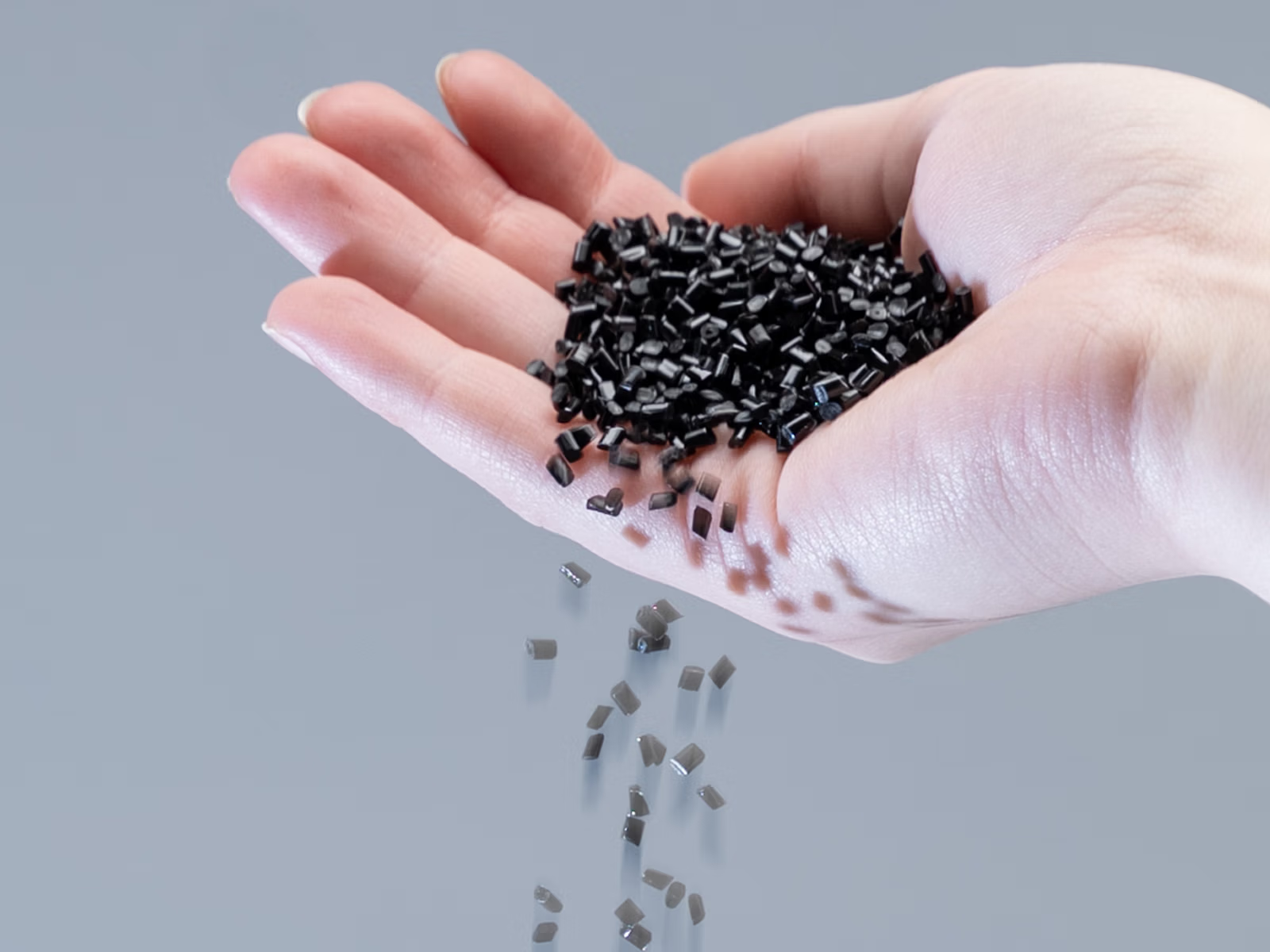
We don’t rely on generic datasheets. Our mapping process matches your part’s mechanical requirements, from high-temp resistance to structural rigidity, with 25 years of real-world material performance data across both Industrial 3D Priting and Injection Molding.

Functional Prototype Accuracy
Move beyond visual models. We utilize Injection Molding and Industrial 3D Printing to produce functional prototypes that mirror the mechanical properties of your final production material, allowing for rigorous testing.
Scalable Tooling Architecture
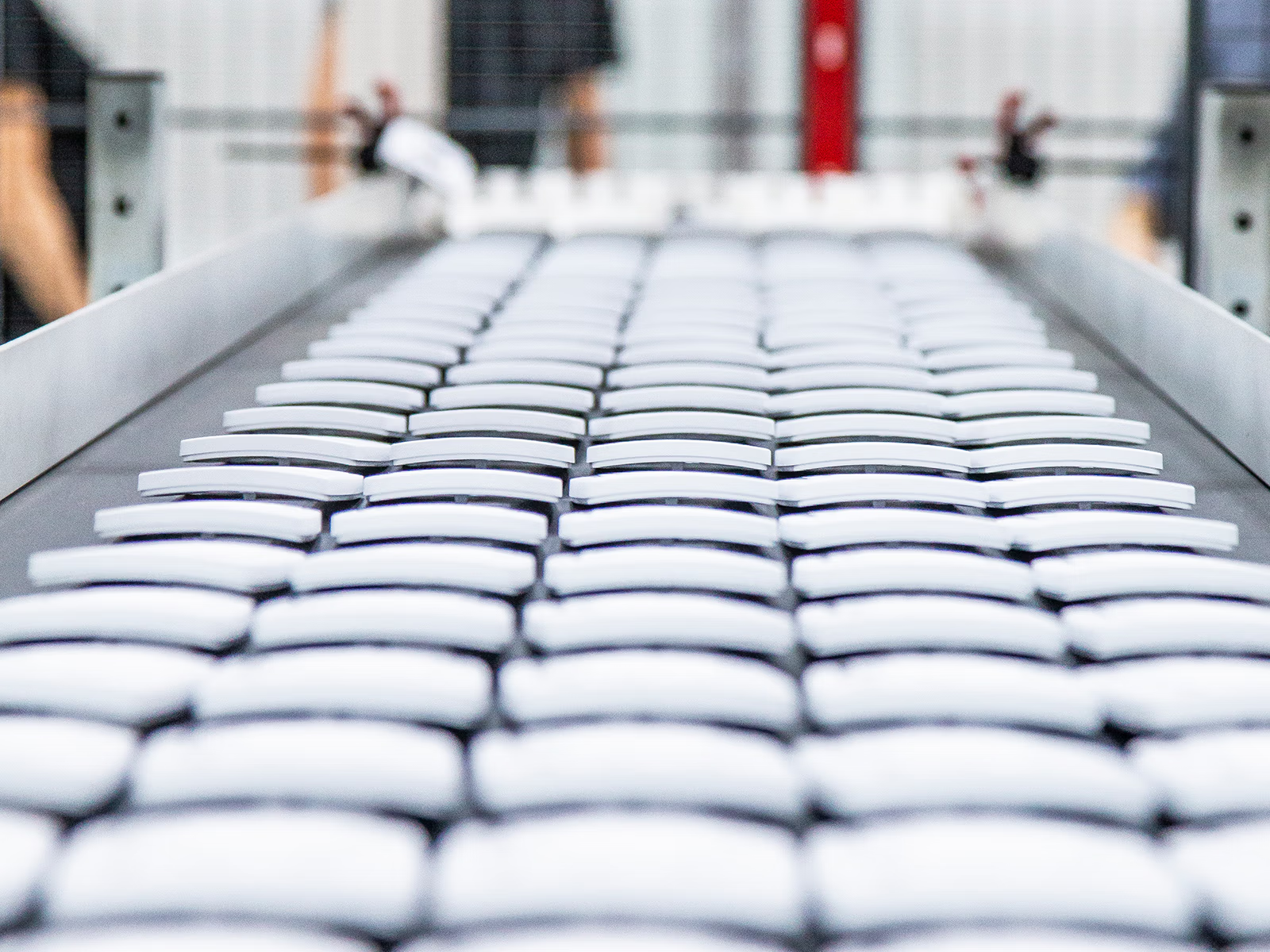
If volume demands long-term stability and the lowest unit cost, our injection molding infrastructure takes over. We use LTV data to transition your project into precision tooling at the optimal economic moment, ensuring a seamless handover from digital to physical production.
Maximizing Your Lifetime Value
By making manufacturing value drivers visible, our Lifetime Value Comparison Tool supports better decision-making on when additive manufacturing can reduce risk, increase flexibility, and enable earlier market returns. In many cases, this allows additive production to remain viable at higher volumes before traditional tooling is required.
These insights are based on Prototal’s 25+ years of experience and industry knowledge; they should be viewed as strategic guidance rather than exact calculations. The purpose is to explore scenarios, understand trade-offs, and identify where manufacturing choices create the greatest lifetime value.
Offering the Right Technology at Every Application
Development
Our team of experts can help you kick off your project from an early design phase.
Scale up
The feasibility study is a key stage in every project. We use multiple manufacturing technologies to find the best way forward.
Serial Production
Supporting production of up to 100,000 parts with Industrial 3D Printing & +50,000 parts with injection molding.
Aftermaket
If changes are needed, we can guide you through the process and handle any necessary adjustments.
Spare parts
Support your products long after EOL with a digital inventory.
Kickstart Your Next Project With Us
Looking for high-quality industrial 3D printing or injection molding solutions tailored to your needs? Our team is ready to help you with your next project.
Why choose us?
- Industrial 3D printing, injection molding and vacuum casting solutions for any scale and complexity
- Fast and accurate quoting process
- Local presence close to your business and business needs

FAQs
Whether you are navigating the transition from prototyping to serial production or optimizing an existing supply chain, we are here to provide the technical clarity you need. If your specific challenge isn’t covered here, our application engineers are ready to discuss your project’s unique requirements and help you find the most efficient path to production.
We don’t rely on estimates; we use our proprietary Lifecycle Value (LTV) Tool. By analyzing your part’s geometry, annual volume, and material requirements against 25 years of manufacturing data, we identify the exact numerical “crossover point.” This ensures you only invest in physical tooling when it becomes the most economically viable path for your project’s ROI.
Absolutely. Modern Additive Manufacturing (AM) has evolved beyond prototyping into a high-volume industrial solution. For complex components or projects requiring high agility, AM can be the definitive production path for runs up to 100,000 units. This approach eliminates tooling CapEx and allows for on-demand scalability and design iterations that traditional molding cannot support.
Yes, that is the core of our Strategic Production Mapping. We manage the entire “digital-to-physical” handover. Once our data shows that injection molding is the optimal path for your volume, our toolmakers engineer and manufacture the necessary steel or aluminum tooling. This integrated infrastructure ensures a seamless transition with zero loss in part precision or quality.
Our tool calculates the environmental ROI by comparing raw material consumption and supply chain logistics. Because industrial 3D printing is an additive process, it significantly reduces material scrap compared to traditional methods. We also factor in the CO2 reduction achieved by producing parts closer to the end-user, eliminating the environmental cost of long-distance freight and overproduction.


